
Module 1: An Invisible World
Section outline
-
 From boiling thermal hot springs to deep beneath the Antarctic ice, microorganisms can be found almost everywhere on Earth in great quantities. Microorganisms (or microbes, as they are also called) are small organisms. Most are so small that they cannot be seen without a microscope.
Most microorganisms are harmless to humans and, in fact, many are helpful. They play fundamental roles in ecosystems everywhere on Earth, forming the backbone of many food webs. People use them to make biofuels, medicines, and even foods. Without microbes, there would be no bread, cheese, or beer. Our bodies are filled with microbes, and our skin alone is home to trillions of them. Some of them we can’t live without; others cause diseases that can make us sick or even kill us.
Although much more is known today about microbial life than ever before, the vast majority of this invisible world remains unexplored. Microbiologists continue to identify new ways that microbes benefit and threaten humans. In this chapter, three sections will address what our ancestors knew, a systematic approach, and a diverse approach.
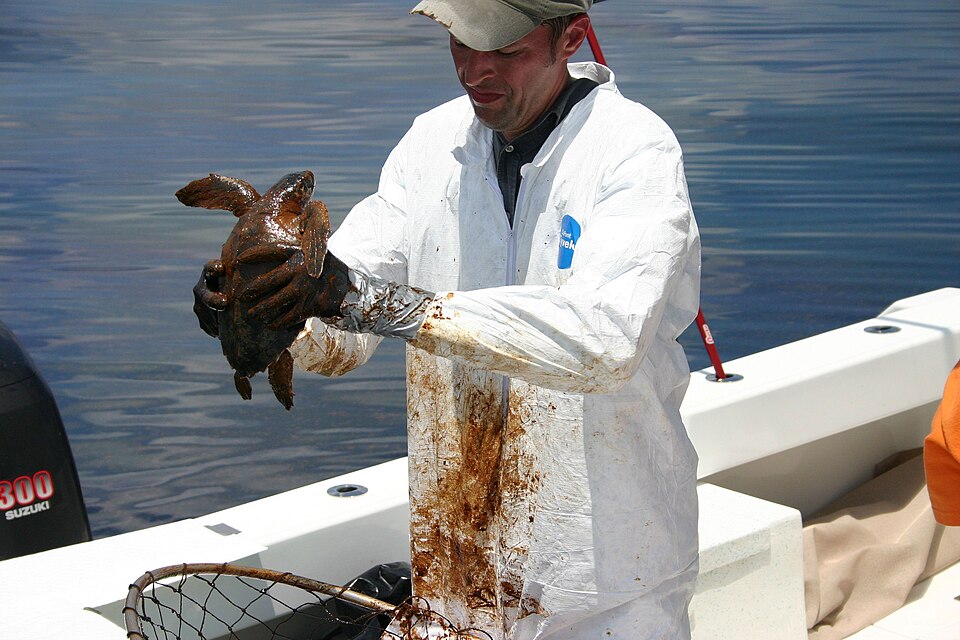
Image: An oiled Kemp's ridley sea turtle. Source: NOAA's National Ocean Service - Flickr: Turtle Rescue and Rehabilitation licensed CC BY 2.0Upon completion of this module, you will be able to:
- Describe how our ancestors improved food with the use of invisible microbes. (C.O. 1, 5 )
- Describe how the causes of sickness and disease were explained in ancient times, prior to the invention of the microscope. (C.O. 1, 2 )
- Describe key historical events associated with the birth of microbiology. (C.O. 1)
- Describe how microorganisms are classified and distinguished as unique species. (C.O. # 1, 3)
- Compare historical and current systems of taxonomy used to classify microorganisms. (C.O. # 1, 3)
- Provide an overview of the field of microbiology. (C.O. # 1, 2, 3 )
To achieve these objectives:
- Read the Module 1 Introduction
- Read Chapter 1 in Medical Microbiology for Nursing and Allied Health: A Louisiana Perspective, Chapter 1: An Invisible World.
- Complete the H5P activity and Chapter 1 quiz.
Note the checkboxes to the right that help you track your progress: some are automatic, and some are manual.
Module Pressbooks Resources and Activities
You will find the following resources and activities in this module at the Pressbooks website. Click on the links below to access or complete each item.
-
-
Dear students, please attempt the H5P activity until you have mastered the content.
-
Dear students,
Please take quiz/assignment during dates of availability:
Dates of availability: xx/xx/202x to xx/xx/202x
Attempts: unlimited within dates of availability.
Grade/score: Highest score of attempt counts.
Length of time per attempt: You have xxx minutes for each attempt.
Uninterrupted attempts required.
Number of questions: There are xx questions.
Contribution towards final grade: yes/no
The quiz has to be taken in the learning management system.
Email or paper submissions will not be accepted.
Sincerely,
XYZ
Background Colour
Font Face
Font Kerning
Font Size
Image Visibility
Letter Spacing
Line Height
Link Highlight
Text Colour