
Module 6: Polynomial and Rational Functions; Variation (Chapter 5)
Section outline
-
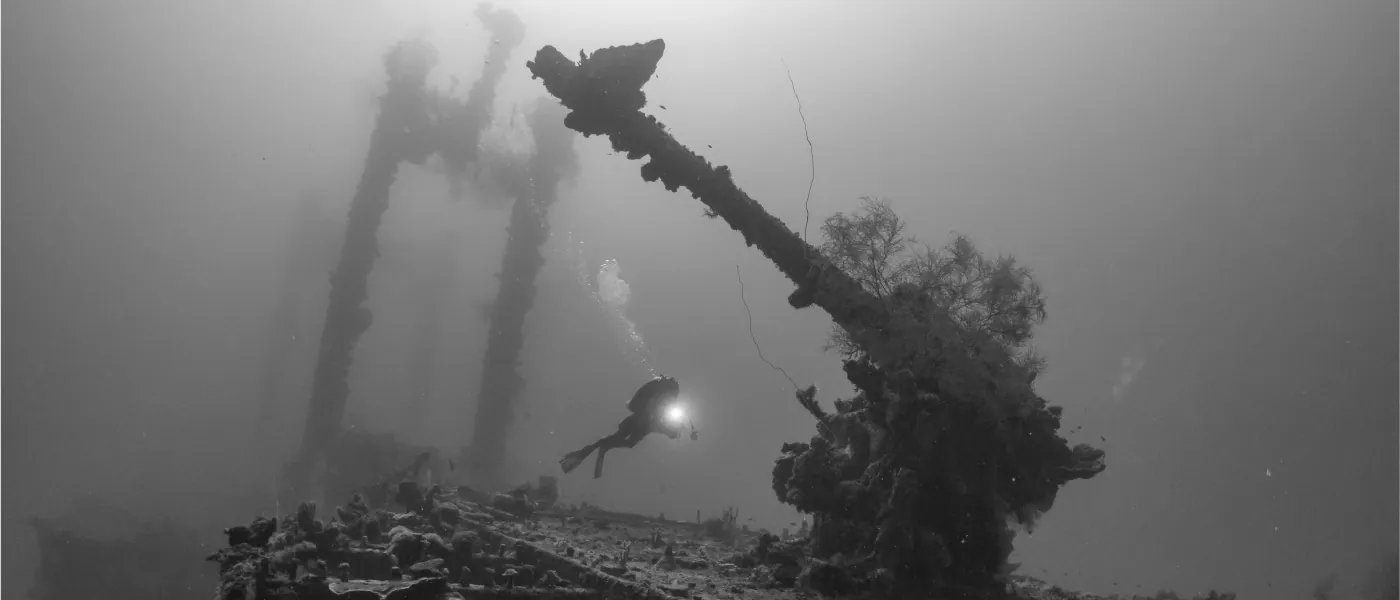
You don't need to dive very deep to feel the effects of pressure. As a person in their neighborhood pool moves eight, ten, twelve feet down, they often feel pain in their ears as a result of water and air pressure differentials. Pressure plays a much greater role at ocean diving depths.
Scuba and free divers are constantly negotiating the effects of pressure in order to experience enjoyable, safe, and productive dives. Gases in a person's respiratory system and diving apparatus interact according to certain physical properties, which upon discovery and evaluation are collectively known as the gas laws. Some are conceptually simple, such as the inverse relationship regarding pressure and volume, and others are more complex. While their formulas seem more straightforward than many you will encounter in this chapter, the gas laws are generally polynomial expressions.
Image Caption: Whether they think about it in mathematical terms or not, scuba divers must consider the impact of functional relationships in order to remain safe. The gas laws, which are a series of relations and equations that describe the behavior of most gases, play a core role in diving. This diver, near the wreck of a World War II Japanese ocean liner turned troop transport, must remain attentive to gas laws during their dive and as they ascend to the surface. (credit: "Aikoku - Aft Gun": modification of work by montereydiver/flickr)
(Content & Image Source: Chapter 5 Introduction, College Algebra with Corequisite Support 2e, Jay Abramson & Sharon North, OpenStax, CC BY 4.0 License)
Upon completion of this module, you will be able to:Section 5.1 Quadratic Functions
Section 5.R Rational Expressions Review (For use with co-requisite support)- Simplify rational expressions.
- Multiply rational expressions.
- Divide rational expressions.
- Add and subtract rational expressions.
- Simplify complex rational expressions
- Recognize characteristics of parabolas. (CLO4, CLO5)
- Compare the graph of a parabola to its quadratic function. (CLO4, CLO5, CLO6)
- Graph quadratic functions. (CLO4, CLO5, CLO6)
- Find the domain and range of a quadratic function. (CLO4, CLO5, CLO6)
- Determine and solve problems involving the minimum and maximum value of a quadratic function (CLO4, CLO5, CLO6)
Section 5.2 Power Functions and Polynomial Functions
- Identify power functions. (CLO4, CLO5)
- Identify end behavior of power functions. (CLO4, CLO5)
- Identify polynomial functions. (CLO4, CLO5)
- Identify the degree and leading coefficient of polynomial functions. (CLO4, CLO5)
Section 5.3 Graphs of Polynomial Functions
- Recognize characteristics of graphs of polynomial functions. (CLO4, CLO5)
- Use factoring to find zeros of polynomial functions. (CLO4, CLO5)
- Identify zeros and their multiplicities. (CLO4, CLO5)
- Determine end behavior. (CLO4, CLO5)
- Understand the relationship between degree and turning points. (CLO4, CLO5)
- Graph polynomial functions. (CLO4, CLO5)
- Use the Intermediate Value Theorem. (CLO4, CLO5)
Section 5.4 Dividing Polynomials
- Use long division to divide polynomials. (CLO4, CLO5)
- Use synthetic division to divide polynomials. (CLO4, CLO5)
Section 5.5 Zeros of Polynomial Functions
- Evaluate a polynomial using the Remainder Theorem. (CLO4, CLO5)
- Use the Factor Theorem to solve a polynomial equation. (CLO4, CLO5)
- Use the Rational Zero Theorem to find rational zeros. (CLO4, CLO5)
- Find zeros of a polynomial function. (CLO4, CLO5)
- Use the Linear Factorization Theorem to find polynomials with given zeros. (CLO4, CLO5)
- Use Descartes’ Rule of Signs. (CLO4, CLO5)
- Solve real-world applications of polynomial equations (CLO4, CLO5)
Section 5.6 Rational Expressions and Functions
- Use arrow notation. (CLO4, CLO5)
- Solve applied problems involving rational functions. (CLO4, CLO5)
- Find the domains of rational functions. (CLO4, CLO5)
- Identify vertical asymptotes. (CLO4, CLO5)
- Identify horizontal asymptotes. (CLO4, CLO5)
- Graph rational functions. (CLO4, CLO5)
Section 5.7 Variation
- Solve direct variation problems. (CLO3, CLO4, CLO6)
- Solve inverse variation problems. (CLO3, CLO4, CLO6)
- Solve problems involving joint variation. (CLO3, CLO4, CLO6)
Section 5.8 Variation: Applications in Science- Use Kepler's Law to calculate the period of planets' orbits around the sun. (CLO3, CLO4, CLO6)
- Relate pressure, volume, amount, and temperature using The Ideal Gas Laws (CLO3, CLO4, CLO6)
(Note: Alignment of MLOs might be needed if this course is taught as a co-requisite.)
To achieve these objectives:- Read the Module 6 Introduction (see above).
- Read Sections 5.R - 5.8 of Chapter 5: Polynomial and Rational Functions; Variation in Applied Algebra (links to each Section provided below)
- At the end of each Section there is a list of Key Concepts, Section Exercises, and a Glossary of terms
- At the end of each Section there is a list of Key Concepts, Section Exercises, and a Glossary of terms
- Complete the MyOpenMath Homework Assignments for each Section (links provided below) - These are graded!
- Complete the MyOpenMath Quiz for Chapter 5 (link provided below) - This is graded!
- Once you complete the Quiz, upload your work in the Quiz for Chapter 5 Work Upload Assignment using the submission link below.
- Post in the Chapter 5 Q&A Discussion Forum - link provided below.
- Complete the Digital Skills - Using the online graphing calculator (Chapter 5) (link provided below) - This is graded!
- Complete the Digital Skills - Using AI for math help (Chapter 5) (link provided below) - This is graded!
Note the check boxes to the right that help you track your progress: some are automatic, and some are manual.Module Pressbooks Resources and Activities
You will find the following resources and activities in this module at the Pressbooks website. Click on the links below to access or complete each item.
For select assessments in this course, students will be allowed to use the following links to online graphing calculators:
- Desmos Calculator
- TI-84 Calculator Online (free version, but not sure how long it will stay active)
- TI-84 Plus CE (*Note: This link requires a paid subscription to be purchased by the student using a credit card.)
-
-
-
Students mustMark as done
-
Background Colour
Font Face
Font Kerning
Font Size
Image Visibility
Letter Spacing
Line Height
Link Highlight
Text Colour