
Module 9: Disease and Epidemiology
Section outline
-
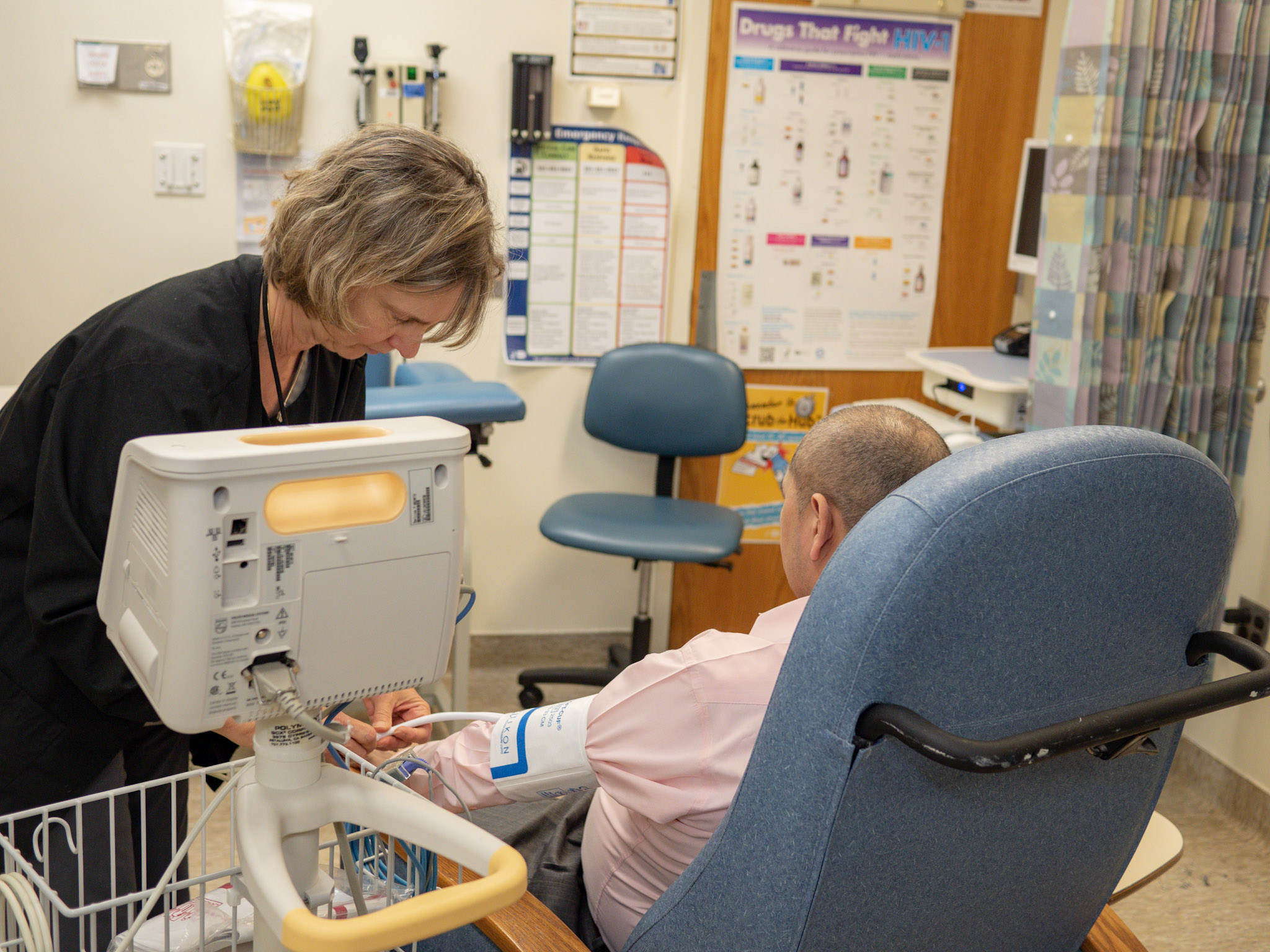
Epidemiology is an interdisciplinary science to understand health phenoma in a population and to control health problems in a population (Principles of Epidemiology by H. Giovanni Antunez) (see figure Epidemiology – Definition and interdisciplinary nature). The definition of epidemiology has changed over the last few decades (Frérot M, Lefebvre A, Aho S, Callier P, Astruc K, Aho Glélé LS. What is epidemiology? Changing definitions of epidemiology 1978-2017. PLoS One. 2018 Dec 10;13(12):e0208442. doi: 10.1371/journal.pone.0208442. PMID: 30532230; PMCID: PMC6287859.).
Image: A medical professional checks the vital signs of a clinical trial study participant. Source: "Medical Examination of a Clinical Trial Volunteer" by NIAID licensed CC BY 2.0
Upon completion of this module, you will be able to:
- Explain the difference between prevalence and incidence of disease (C.O. #4)
- Distinguish the characteristics of sporadic, endemic, epidemic, and pandemic diseases (C.O. #3 and 4)
- Explain the use of Koch’s postulates and their modifications to determine the etiology of disease (C.O. #3, 4 and 5)
- Explain the relationship between epidemiology and public health (C.O. #4 and 5)
- Explain the research approaches used by the pioneers of epidemiology (C.O. #4 and 5)
- Explain how descriptive, analytical, and experimental epidemiological studies go about determining the cause of morbidity and mortality (C.O. #4)
- Describe the different types of disease reservoirs (C.O. #3 and 4)
- Compare contact, vector, and vehicle modes of transmission (C.O. #3 and 4)
- Identify important disease vectors (C.O. #3 and 4)
- Explain the prevalence of nosocomial infections (C.O. #3, 4, and 5)
- Describe the entities involved in international public health and their activities (C.O. #4 and 5)
- Identify and differentiate between emerging and reemerging infectious diseases (C.O. #3 and 4)
- Evaluate how modern surveillance systems using digital tools (e.g., CDC, KFF (Kaiser Family Foundation), WHO, or GIS-based tools) continue to influence outbreak response, prevention, and immunization strategies. (C.O. #4, 5, and 6)
- Using an example of one of the digital tools listed in question 13, prepare examples of charts and graphs demonstrating the most reported disease in your state (C.O. #4, 5, and 6).
To achieve these objectives:
[Welcome to this module! To be successful, please complete the activities in the sequence listed below. Each activity is designed to build your microbiology knowledge while also strengthening essential digital, scientific, and communication skills needed for today’s workforce.]
- Read the Module 9 Introduction: This provides the purpose of the module, key themes, and the learning outcomes you are expected to achieve by the end.
- Read Chapter 9 in Medical Microbiology for Nursing and Allied Health: A Louisiana Perspective
- Complete the [following activities in order. Check off each box as you go.]
Module To-Do List (Student Tracking Checklist)
Epidemiology & Infectious Disease Patterns
Complete the following activities in order. Check off each box as you go.
1. Review the Module Overview
☐ Begin by reading the Module Overview page.
☐ Understand the purpose of the module, key epidemiological concepts, and links to public health and clinical practice.
2. Complete the Required Readings
☐ Prevalence vs. Incidence of Disease
☐ Patterns of Disease Occurrence (Sporadic, Endemic, Epidemic, Pandemic)
☐ Koch’s Postulates and Modified Postulates
☐ Relationship Between Epidemiology and Public Health
☐ Pioneers of Epidemiology and Their Research Approaches
☐ Types of Epidemiological Studies (Descriptive, Analytical, Experimental)
☐ Disease Reservoirs
☐ Modes of Disease Transmission (Contact, Vehicle, Vector)
☐ Nosocomial (Healthcare-Associated) Infections
☐ International Public Health Organizations
☐ Emerging and Reemerging Infectious Diseases
3. Watch the Module Lecture Videos
☐ Measuring Disease: Prevalence and Incidence
☐ Disease Patterns and Outbreak Classifications
☐ Epidemiology, Public Health, and Koch’s Postulates
☐ Epidemiologic Study Designs
☐ Transmission, Reservoirs, and Healthcare-Associated Infections
☐ Global and Emerging Infectious Diseases
☐ Digital Skill: Digital Content Navigation
4. Complete the Learning Check (Self-Assessment Quiz)
☐ Complete the Module/Lecture H5P Activities or self-assessment quiz on epidemiological concepts
☐ Digital Skill: Digital Assessment Tools
5. Participate in the Discussion Forum
☐ Post your initial discussion response
☐ Reply to at least two classmates
☐ Digital Skill: Scientific Communication in Digital Spaces
6. Explore Modern Disease Surveillance Tools
☐ Review CDC, WHO, KFF, and GIS-based tools
☐ Digital Skill: Public Health Data Literacy
7. Complete the Data Visualization Assignment
☐ Identify the most frequently reported disease in your state
☐ Create charts and/or graphs
☐ Digital Skill: Data Visualization Using Digital Tools
☐ Digital Skill: Digital Productivity Tools
8. Submit Your Assignment
☐ Upload charts/graphs with proper labeling
9. Review Instructor Feedback
☐ Review grading feedback in the LMS
☐ Digital Skill: Using Digital Feedback Tools
10. Complete the Module Reflection
☐ Respond to the reflection prompt on epidemiological data and community health
☐ Digital Skill: Reflective Practice Using Digital Tools
Module Pressbooks Resources and Activities
You will find the following resources and activities in this module at the Pressbooks website. Click on the links below to access or complete each item.
-
-
This file contains the PowerPoint Slides for Module 9. I am also including this file as a PDF version. You can locate the PDF version just below this file.
-
This file contains the PDF version of the Chapter 2 PowerPoint slides. This PDF file allows you to have access to the slides if MS PowerPoint is not readily available. Thank you.
-
Students mustMark as done
Forum Instructions
In a post below, respond to the following prompt:
Discussion Prompt
Epidemiology is often referred to as the “cornerstone of public health” because it enables scientists and clinicians to track the origin, spread, and control of infectious diseases.
For this discussion, reflect on your learning from the Module 9 assignment and respond to the following prompts:
1. Select one infectious disease (historical or emerging) that has significantly shaped human health on a regional or global scale.
2. Discuss how epidemiological principles—such as incidence, prevalence, morbidity, mortality, and transmission dynamics—were applied to understand or control this disease.
3. Evaluate how modern disease surveillance systems (e.g., CDC, WHO, MMWR, or GIS-based tracking tools) influence outbreak response, prevention strategies, and immunization efforts.
4. Conclude by proposing one improvement or innovation in epidemiologic research, surveillance, or science communication that could enhance global health outcomes.
Students should support their discussion with credible scientific sources, including the CDC's Morbidity and Mortality Weekly Reports (MMWR), WHO Situation Reports, or peer-reviewed journals.Peer Response Requirement
After posting your initial response, respond to at least two classmates’ posts by:
• Comparing their selected disease with yours,
• Expanding on how epidemiological tools were applied differently across diseases or regions, or
• Offering additional insight into surveillance, prevention, or public health communication strategies.
Each peer response should be thoughtful, respectful, and at least 100 words in length.Guidelines for Participation
• Initial Post: 250–300 words
• Peer Responses: Two responses, minimum 100 words each
• Use accurate epidemiological terminology and maintain a professional academic tone
• Cite credible sources (CDC, WHO, MMWR, peer-reviewed journals) using APA or MLA format
• Submit posts by the assigned deadlines to ensure full participationEvaluation Criteria
Students will be evaluated based on their understanding and application of epidemiological principles, the depth of their analysis, the use of credible sources, the quality of their peer engagement, and the clarity and professionalism of their written communication.
Discussion Forum Scoring Rubric (Total: 30 Points)
Excellent
- Epidemiological Content & Accuracy: Strong understanding and correct application of epidemiological principles
- Application & Critical Analysis: Clear connections between disease data, surveillance, and public health outcomes
- Use of Sources & Evidence: Credible, well-integrated, and properly cited sources
- Peer Responses: Two thoughtful responses that extend the discussion
- Writing Quality & Professionalism: Clear, organized, scientific tone with minimal errors
Satisfactory
- Epidemiological Content & Accuracy: Minor inaccuracies or limited explanation
- Application & Critical Analysis: Some connections made with limited depth
- Use of Sources & Evidence: Sources used but weakly integrated or cited
- Peer Responses: Responses meet minimum requirements
- Writing Quality & Professionalism: Minor writing or grammar issues
Needs Improvement
- Epidemiological Content & Accuracy: Major misconceptions or weak understanding
- Application & Critical Analysis: Minimal analysis or vague connections
- Use of Sources & Evidence: Few, inappropriate, or missing sources
- Peer Responses: Minimal or superficial engagement
- Writing Quality & Professionalism: Frequent errors or informal tone
-
Students mustMark as done
Instructions
This assignment addresses course outcome(s)
Student Learning Outcomes Addressed• SLO 13: Evaluate how modern surveillance systems using digital tools influence outbreak response, prevention, and immunization strategies.
• SLO 14: Using one digital surveillance tool, prepare charts and graphs demonstrating the most reported disease in your state.
Course Outcomes: C.O. #4, #5, and #6Assignment Overview
Epidemiology relies on modern digital surveillance systems to monitor disease trends, detect outbreaks, and guide prevention and immunization strategies. In this assignment, students will evaluate a real-world digital surveillance tool and apply epidemiological data to analyze disease patterns within their state.
Part I – Digital Surveillance Systems and Public Health Impact (30 points)
Select one digital surveillance system:
• CDC (CDC WONDER, NNDSS, FluView)
• WHO surveillance dashboards
• Kaiser Family Foundation (KFF)
• GIS-based epidemiology tools
In 2–3 typed pages, students must:
• Describe the purpose of the surveillance system.
• Explain how data are collected and presented.
• Evaluate how the system supports outbreak response, prevention, and immunization strategies.
• Discuss strengths and limitations of digital surveillance tools.Part II – State Disease Surveillance Data Analysis (35 points)
Using the same digital surveillance tool:
• Identify the most frequently reported infectious disease in your state.
• Create at least two charts or graphs (bar, line, pie, or GIS map).
• Provide a 1–2 paragraph interpretation for each visual explaining trends, public health implications, and prevention or immunization strategies.Submission & Formatting Requirements
• Combined written paper with Parts I and II
• Charts/graphs embedded or attached
• References page (APA or MLA)
Formatting:
• 12-point font, double-spaced
• 3–4 pages total (excluding visuals and references)
• Scientific tone and proper citationsAssessment Summary (100 Points Total)
• Evaluation of Digital Surveillance System – 30 points
• Disease Identification & Data Selection – 15 points
• Charts & Graphs (Accuracy & Clarity) – 20 points
• Data Interpretation & Public Health Implications – 25 points
• Writing Quality & Citations – 10 points -
Dear students,
The quiz addresses the following course objectives:
C.O. #4 Understand the principles of epidemiology and the methods used to study the spread and control of infectious diseases.
C.O.#5 Integrate their understanding of microbiology into their clinical practice, contribute to infection prevention and control, and effectively communicate microbiological concepts to a diverse audience.The quiz also responds to the module objectives #1-#13.
Please take quiz/assignment during dates of availability:
Dates of availability: xx/xx/202x to xx/xx/202x
Attempts: unlimited within dates of availability.
Grade/score: Highest score of attempt counts.
Length of time per attempt: You have xxx minutes for each attempt.
Uninterrupted attempts required.
Number of questions: There are xx questions.
Contribution towards final grade: yes/no
The quiz has to be taken in the learning management system, in this case canvas or moodle.
Email or paper submissions will not be accepted.
Sincerely,
-
Dear students,
The quiz addresses the following course objectives:
C.O. #4 Understand the principles of epidemiology and the methods used to study the spread and control of infectious diseases.
C.O.#5 Integrate their understanding of microbiology into their clinical practice, contribute to infection prevention and control, and effectively communicate microbiological concepts to a diverse audience.The quiz also responds to the module objectives #1-#13.
Please take quiz/assignment during dates of availability:
Dates of availability: xx/xx/202x to xx/xx/202x
Attempts: unlimited within dates of availability.
Grade/score: Highest score of attempt counts.
Length of time per attempt: You have xxx minutes for each attempt.
Uninterrupted attempts required.
Number of questions: There are xx questions.
Contribution towards final grade: yes/no
The quiz has to be taken in the learning management system, in this case canvas or Moodle.
Email, paper, or any other type of submissions will not be accepted.
Sincerely,
Illya Tietzel
- Explain the difference between prevalence and incidence of disease (C.O. #4)
Background Colour
Font Face
Font Kerning
Font Size
Image Visibility
Letter Spacing
Line Height
Link Highlight
Text Colour