
Module 11: Adaptive Specific Host Defenses
Section outline
-
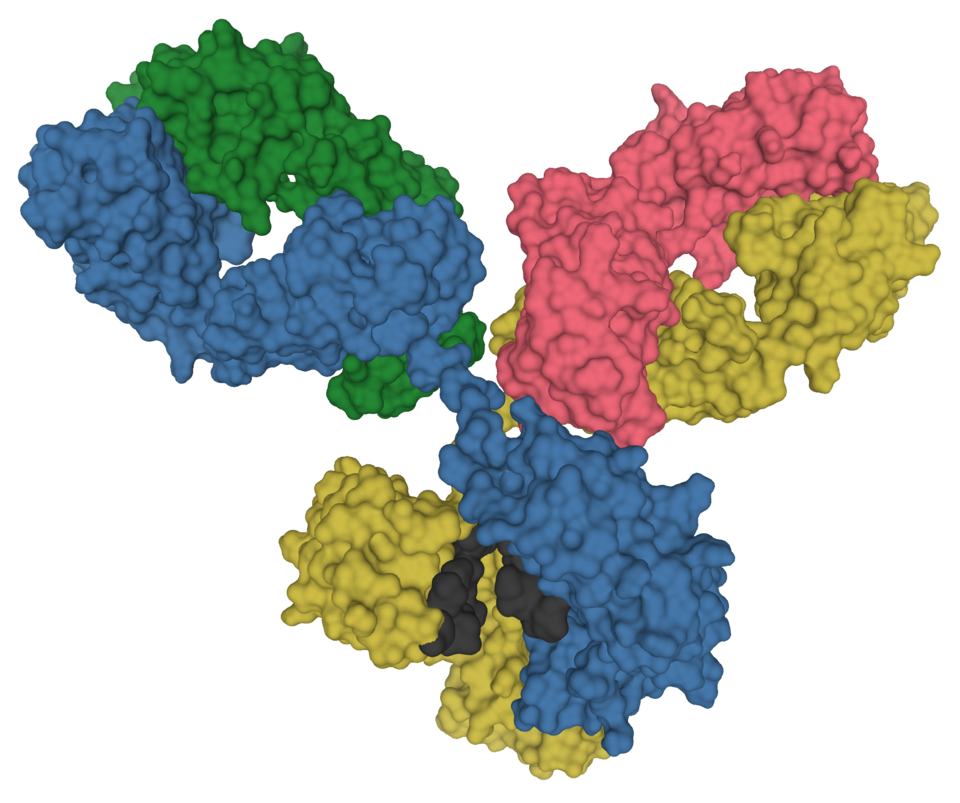
In this module, we build on your understanding of innate immune defenses to explore adaptive immunity, the arm of the immune system responsible for specificity and long-term protection. You will examine how B cells and T cells recognize antigens, become activated, and work together to eliminate pathogens. Key topics include antigen presentation, antibody production, immune regulation, and the development of immune memory.
These concepts are essential for understanding how vaccines work, why prior exposure to pathogens matters, and how immune responses are used in clinical diagnosis and treatment. Whether you are pursuing a career in healthcare, laboratory science, public health, or simply strengthening your scientific literacy, this module connects immune system mechanisms to real-world health and disease. Antibody IgG1 surface model, by Vossman, CC BY-SA 4.0, via Wikimedia Commons.
Upon completion of this module, you will be able to:
- Define memory, primary response, secondary response, and specificity (CO#2)
- Distinguish between humoral and cellular immunity (CO#2)
- Differentiate between antigens, epitopes, and haptens (CO#2)
- Describe the structure and function of antibodies and distinguish between the different classes of antibodies (CO#2)
- Identify cells that express MHC I and/or MHC II molecules and describe the structures and cellular location of MHC I and MHC II molecules (CO#2)
- Identify the cells that are antigen-presenting cells (CO#2)
- Describe the process of antigen processing and presentation with MHC I and MHC II (CO#2)
- Describe the process of T-cell maturation and thymic selection (CO#2)
- Explain the genetic events that lead to diversity of T-cell receptors (CO#2)
- Compare and contrast the various classes and subtypes of T cells in terms of activation and function (CO#2)
- Explain the mechanism by which superantigens effect unregulated T-cell activation (CO#2)
- Describe the production and maturation of B cells (CO#2)
- Compare the structure of B-cell receptors and T-cell receptors (CO#2)
- Compare T-dependent and T-independent activation of B cells (CO#2)
- Compare the primary and secondary antibody responses (CO#2)
- Compare the various types of immunity (CO#2)
- Differentiate between variolation and vaccination (CO#2)
- Describe different types of vaccines and explain their respective advantages and disadvantages (CO#2)
To achieve these objectives:
[Edit these items to match your resources and activities.]
- Read the Module 11 Introduction
- Read Chapter 11 in Medical Microbiology for Nursing and Allied Health: A Louisiana Perspective
- Review Chapter 11 Slides
- Complete the review questions
Module Pressbooks Resources and Activities
You will find the following resources and activities in this module at the Pressbooks website. Click on the links below to access or complete each item.
Background Colour
Font Face
Font Kerning
Font Size
Image Visibility
Letter Spacing
Line Height
Link Highlight
Text Colour