
Module 4: Cadiovascular II Blood Vessels
Section outline
-
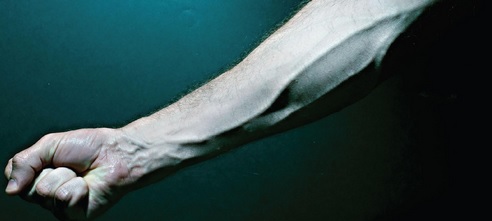
Figure 4.1 Blood Vessels. While most blood vessels are located deep from the surface and are not visible, the superficial veins of the upper limb provide an indication of the extent, prominence, and importance of these structures to the body. (credit: Colin Davis)
Module Overview
The cardiovascular system's blood vessels are essential delivery systems. They form an intricate tubule network that transports blood throughout your body, delivering oxygen and nutrients while removing waste. Blood vessels are essential for keeping every organ and tissue alive and functioning. There are three main types of blood vessels, each with a distinct role. Arteries carry oxygen-rich blood away from the heart to the body. Veins return oxygen-poor blood back to the heart after systemic circulation. Capillaries are tiny vessels that connect arteries and veins, allowing the exchange of gases, nutrients, and waste between blood and tissues.
Module Learning Objectives Upon completion of this module, you will be able to:
- Compare and contrast the anatomical structure of arteries, arterioles, capillaries, venules, and veins (CLO1, CLO2, CLO3, CLO4)
- Accurately describe the forces that account for capillary exchange (CLO1, CLO2, CLO3, CLO4)
- List the major factors affecting blood flow, blood pressure, and resistance (CLO1, CLO2, CLO3, CLO4)
- Describe how blood flow, blood pressure, and resistance interrelate (CLO1, CLO2, CLO3, CLO4)
- Discuss how the neural and endocrine mechanisms maintain homeostasis within the blood vessels (CLO1, CLO2, CLO3, CLO4)
- Describe the interaction of the cardiovascular system with other body systems (CLO1, CLO2, CLO3, CLO4)
- Label the major blood vessels of the pulmonary and systemic circulations (CLO1, CLO2, CLO3, CLO4)
- Identify and describe the hepatic portal system (CLO1, CLO2, CLO3, CLO4)
- Describe the development of blood vessels and fetal circulation (CLO1, CLO2, CLO3, CLO4)
- Compare fetal circulation to that of an individual after birth (CLO1, CLO2, CLO3, CLO4)
To achieve these objectives:
- Read the Module 4 Introduction
- Read Chapter 4 in Textbook
- Complete the activities below
Review Cardiovascular Blood Vessels module which aligns with MLO1 to MLO10, CLO1 to CLO4 to complete review topics 4.1 to 4.7 using the textbook to complete H5P (Tool: H5P).
-
Review Cardiovascular Blood Vessels module which aligns with MLO1, CLO1 to CLO4 to participate in discussion board assignment Blood Vessels using discussion forum rubric to complete discussion board assignment (CANVAS Tool: Discussion Forum).
-
Review Cardiovascular Blood Vessels module which aligns with MLO1 to MLO10, CLO1 to CLO4 to complete quiz using the textbook (CANVAS Tool: Quiz).
Module Pressbooks Resources and Activities
You will find the following resources and activities in this module at the Pressbooks website. Click on the links below to access or complete each item.
-
Opened: Wednesday, July 30, 2025, 9:47 PMStudents mustMark as done
-
Background Colour
Font Face
Font Kerning
Font Size
Image Visibility
Letter Spacing
Line Height
Link Highlight
Text Colour