
Module 10: Urinary
Section outline
-
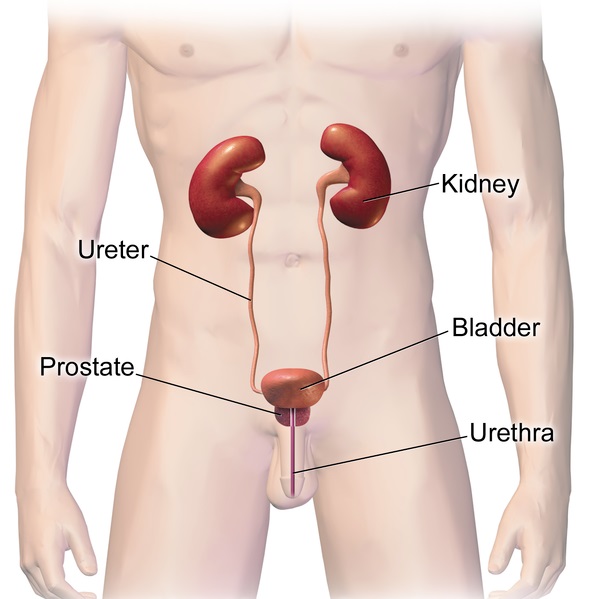
Image: A medical illustration depicting a male's urinary system. Creative Commons Attribution-Share Alike 4.0 International license.
You’ve already learned how the body takes in nutrients and oxygen—but just as important is how it removes what it no longer needs. The urinary system is the body’s primary way of filtering blood, regulating fluid balance, and eliminating waste. You may recall its connection to homeostasis and blood pressure regulation from previous modules. In this section, we’ll explore how the kidneys, ureters, bladder, and urethra work together to keep the internal environment stable and clean.
This module will take you inside the nephron—the functional unit of the kidney—to see how filtration, reabsorption, and secretion happen at the microscopic level. We’ll also look at how hormones like ADH and aldosterone influence urine production and why the urinary system is critical for maintaining proper electrolyte levels and blood pressure. For anyone pursuing a career in healthcare, fitness, or life sciences, understanding the urinary system is essential for interpreting lab values, managing hydration, recognizing signs of kidney dysfunction, and supporting overall health. This is a system that does much more than eliminate waste—it quietly protects the body’s internal balance every single day.
Upon completion of this module, you will be able to:
- Describe the composition of urine (CLOs 1-2)
- Label structures of the urinary system (CLOs 1-2)
- Characterize the roles of each of the parts of the urinary system (CLOs 1-3)
- Illustrate the macroscopic and microscopic structures of the kidney (CLOs 1-3)
- Trace the flow of blood through the kidney (CLOs 1-4)
- Outline how blood is filtered in the kidney nephron (CLOs 1-4)
- Provide symptoms of kidney failure (CLO 5)
- List some of the solutes filtered, secreted, and reabsorbed in different parts of the nephron (CLOs 1-4)
Describe the role of a portal system in the kidney (CLOs 1-4)
Explain how urine osmolarity is hormonally regulated (CLOs 1-4)
Describe the regulation of major ions by the kidney (CLOs 1-4)
Summarize the role of the kidneys in maintaining acid–base balance (CLOs 1-6)
To achieve these objectives:
- Read the Module 10 Introduction
- Read and view the materials in the Module # Pressbooks book
- Read Chapter 10 in Textbook
- Complete the activities below.
Module Pressbooks Resources and Activities
You will find the following resources and activities in this module at the Pressbooks website. Click on the links below to access or complete each item.
Background Colour
Font Face
Font Kerning
Font Size
Image Visibility
Letter Spacing
Line Height
Link Highlight
Text Colour