
Becoming a Savvy Online Researcher
Section outline
-
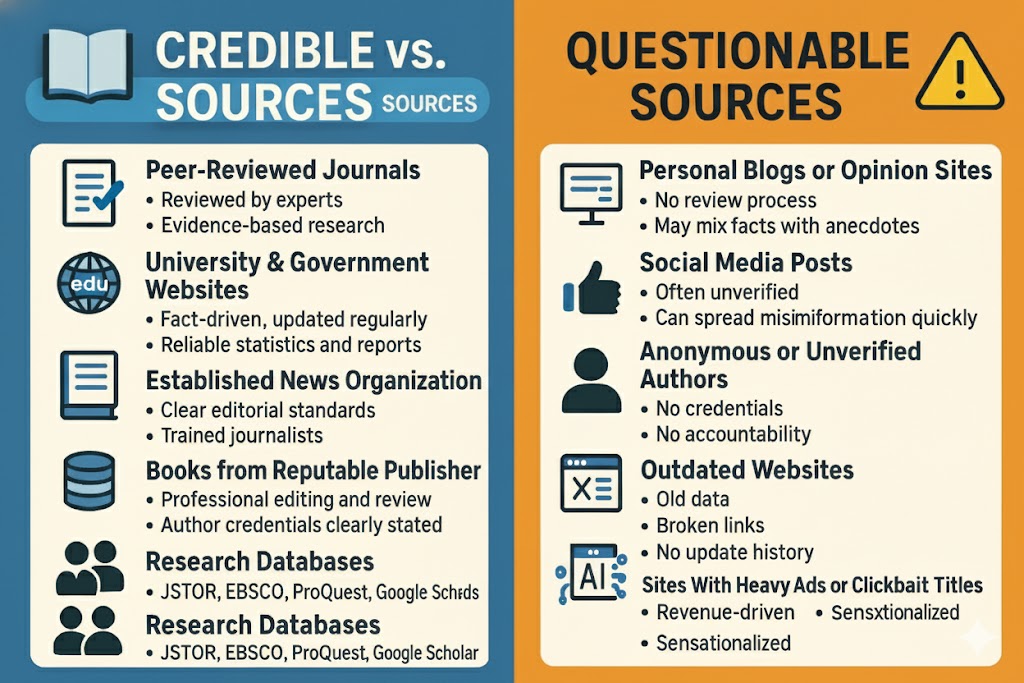
In today's rapidly evolving digital landscape, the ability to locate, evaluate, and ethically use information is no longer optional—it is foundational to academic success, professional advancement, and informed citizenship. Colleges, employers, and global leaders emphasize that we now live in a world where information is abundant, technology is accelerating exponentially, and the ability to think critically is one of the most valuable human skills.
This chapter will guide you in developing the competencies needed to thrive in this environment. You will learn to distinguish credible sources from misinformation and low-quality content, apply advanced digital-research strategies across academic databases and online platforms, and accurately cite digital information using accepted style guides. These skills align with current research that emphasizes digital literacy, media literacy, and AI literacy as essential competencies for 21st-century learners.
Recent literature highlights that, as artificial intelligence, algorithms, and user-generated content continue to shape the information we consume, individuals must be able to:
-
Recognize bias, authorship, and intent in digital content
-
Evaluate the reliability of emerging formats such as AI-generated text, social media posts, and multimodal information
-
Use academic databases, digital libraries, and machine-assisted research tools effectively
-
Verify facts across multiple credible sources
-
Understand the ethics of information use, including plagiarism, attribution, and digital footprint
Research skills are becoming increasingly important because technology is not only advancing, but it is also accelerating. According to global digital-literacy studies, the volume of online information doubles at unprecedented rates, misinformation spreads more quickly than verified facts, and AI-assisted tools can both support and complicate the research process.
For this reason, strong research literacy is one of the most critical lifelong skills you can develop. Students who master digital and AI-enhanced research are better equipped to learn independently, adapt to new technologies, and participate confidently in academic and professional spaces.
In short, this chapter will prepare you to become not only a consumer of information but also a producer of knowledge. Still, a wise evaluator and skilled researcher—equipped to navigate the digital world with clarity, confidence, and integrity.
Upon completion of this module, you will be able to:
- Differentiate between credible and untrustworthy sources using criteria such as authority, expertise, and potential bias. (Analyze)
- Apply advanced research techniques in databases and online resources. (Apply)
- Produce accurate citations of online sources using a required style guide. (Apply)
To achieve these objectives:
- Read the Module Becoming a Savvy Online Researcher
- Complete the Assignments
Module Pressbooks Resources and Activities
You will find the following resources and activities in this module at the Pressbooks website. Click on the links below to access or complete each item.
-
Students mustMark as done
Guidelines for how to import content into Moodle
-
-
Background Colour
Font Face
Font Kerning
Font Size
Image Visibility
Letter Spacing
Line Height
Link Highlight
Text Colour