
Module 5: Lab Activity on Aseptic Techniques and Media Preparation
Section outline
-
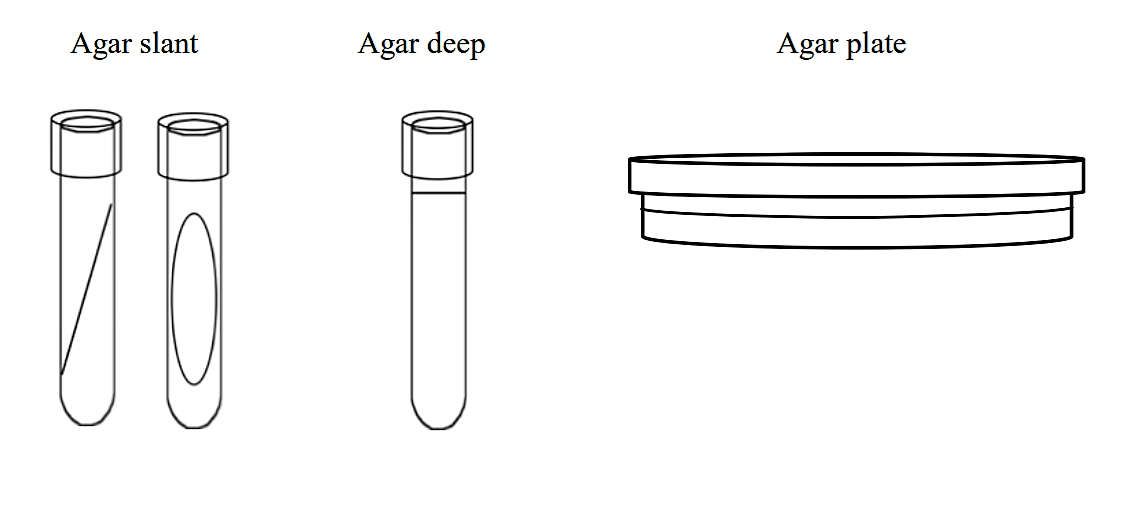
To study bacteria and other microorganisms, it is necessary to grow them in controlled conditions in the laboratory. Growth media contain a variety of nutrients necessary to sustain the growth of microorganisms. There are two commonly used physical forms of growth media: liquid media and solid growth media. A liquid medium is called a broth. Solid growth media usually contains agar, which is a mixture of polysaccharides derived from red algae. It is used as a solidification agent because it (1) is not broken down by bacteria, (2) contains no nutrients that can be used by bacteria and (3) melts at high temperatures, and yet is solid at temperatures used for most bacterial growth. Solid growth media is used in the following forms: agar plates, agar slants and agar deeps. To make agar deeps or agar slants, melted agar is poured into a test tube and then allowed to solidify vertically (agar deep), or at a slant (agar slant). Agar plates are made by pouring melted agar into a petri dish. (Image: Agar.png by Joan Petersen & Susan McLaughlin, from LibreText Biology under license CC BY-NC-SA 4.0)
Upon completion of this module, you will be able to:- Demonstrate proper aseptic technique during media preparation, culture handling, and inoculation procedures (Course Outcomes #3, 5 & 6)
- Prepare common microbiological culture media following established laboratory protocols. (C.O. #3, 5 & 6)
- Explain the purpose and composition of different types of culture media and calculate the required media for preparation (general-purpose, selective, differential, and enriched media).(C.O. #3 & 5)
- Inoculate, incubate, and interpret results of bacterial cultures using aseptic techniques in face-to-face or virtual laboratory settings. (C.O. #3, 5, & 6)
- Enumerate bacterial growth using the standard plate count method and interpret results. (C.O. #3 & 6)
- Utilize digital tools or virtual laboratory platforms to simulate aseptic techniques and analyze experimental outcomes. (C.O. #6)
- Apply aseptic technique and media preparation skills to clinical and public health scenarios relevant to nursing and allied health. (C.O. #5 & 6)
- Interpret experimental results related to media preparation, contamination control, and microbial growth. (C.O. #3, 5, & 6)
To achieve these objectives:
[Welcome to this module! To be successful, please complete the activities in the sequence listed below. Each activity is designed to build your microbiology knowledge while also strengthening essential digital, scientific, and communication skills needed for today’s workforce.]
- Read the Module 5 Introduction: This provides the purpose of the module, key themes, and the learning outcomes you are expected to achieve by the end of this lab.
- Read Lab Activity Lab 5 Aseptic Techniques and Media Preparation Lisa Mims-Devezin – Medical Microbiology for Nursing and Allied Health Lab Manual
- Complete the [following activities in order. ** Please click on the fillable checklist for this laboratory Module and as you complete each activity, check off each box as you go.]
To successfully complete this laboratory module, follow each step in the order listed below. Check off each item as you complete it. Follow the steps in order. These activities are designed to help you develop safe microbiological practices, laboratory confidence, and skills applicable to clinical and public health settings.
1. Review the Laboratory Module Overview
☐ Read the Lab Module Overview page
☐ Review the importance of aseptic technique in microbiology
☐ Understand how contamination impacts patient safety, diagnostics, and research
☐ Review expectations for face-to-face or virtual lab participation
2. Review Laboratory Safety and Aseptic Technique Guidelines
☐ Review laboratory safety rules and PPE requirements
☐ Review principles of aseptic technique
☐ Review proper use of flame, biosafety cabinets, and sterile work areas
3. Watch the Aseptic Technique Demonstration Videos
☐ Introduction to Aseptic Technique
☐ Proper Handling of Cultures and Media
☐ Sterilization of Tools and Work Areas
☐ Preventing Contamination During Transfers
☐ Foundational Digital Skill: Digital Content Navigation
4. Complete the Media Preparation Reading
☐ Review types of culture media
☐ Review media components and their functions
☐ Review sterilization methods
5. Perform the Media Preparation Activity
☐ Prepare culture media following laboratory protocol (face-to-face or virtual simulation)
☐ Label media correctly (name, date, medium type)
☐ Sterilize media using approved methods
☐ Industry-Specific Digital Skill (Virtual): Laboratory Simulation Tools
☐ Foundational Digital Skill: Procedural Accuracy in Digital Environments
6. Demonstrate Aseptic Transfer Techniques
☐ Inoculate prepared media with provided cultures
☐ Transfer microorganisms between media without contamination
☐ Properly incubate cultures according to protocol
7. Perform the Standard Plate Count Activity
☐ Prepare serial dilutions
☐ Plate diluted samples using aseptic technique
☐ Count colonies and calculate CFU/mL
☐ Foundational Digital Skill: Quantitative Reasoning Using Digital Tools
8. Record and Analyze Experimental Results
☐ Record observations and measurements
☐ Identify possible sources of contamination
☐ Interpret growth patterns and plate count results
☐ Foundational Digital Skill: Digital Data Entry and Analysis
9. Complete the Laboratory Assessment
☐ Complete the lab quiz covering aseptic technique, media preparation, and plate counts
☐ Foundational Digital Skill: Digital Assessment Tools
10. Submit the Laboratory Report or Worksheet
☐ Upload completed lab worksheet or report
☐ Include calculations, interpretations, and screenshots if applicable
11. Review Instructor Feedback
☐ Review instructor feedback using the LMS grading tool
☐ Foundational Digital Skill: Using Digital Feedback Tools
12. Complete the Laboratory Reflection
☐ Respond to the reflection prompt on aseptic technique and patient safety
☐ Industry-Specific Digital Skill: Reflective Practice in Healthcare Education
Module Pressbooks Resources and Activities
You will find the following resources and activities in this module at the Pressbooks website. Click on the links below to access or complete each item.
-
-
This file contains the PowerPoint Slides for Module 5 Lab Activity on Aseptic Technique and Media Preparation. I am also including this file as a PDF version. You can locate the PDF version just below this file.
-
This file contains the PDF version of the Laboratory Module 5: Aseptic Technique and Media Preparation PowerPoint slides. This PDF file provides access to the slides if Microsoft PowerPoint is not readily available. Thank you.
-
Students mustMark as done
-
Students mustPost replies: 1Make forum posts: 1
- Demonstrate proper aseptic technique during media preparation, culture handling, and inoculation procedures (Course Outcomes #3, 5 & 6)
Background Colour
Font Face
Font Kerning
Font Size
Image Visibility
Letter Spacing
Line Height
Link Highlight
Text Colour