
Module 7: Lab Activity on Endospore Staining
Section outline
-
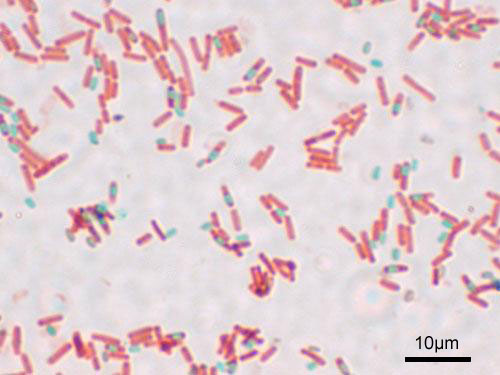
Endospores are dormant forms of living bacteria and should not be confused with reproductive spores produced by fungi. These structures are produced by a few genera of Gram-positive bacteria, almost all bacilli, in response to adverse environmental conditions. Two common bacteria that produce endospores are Bacillus or Clostridum. Both live primarily in soil and as symbionts of plants and animals, and produce endospores to survive in an environment that change rapidly and often.
The process of endosporulation (the formation of endospores) involves several stages. After the bacterial cell replicates its DNA, layers of peptidoglycan and protein are produced to surround the genetic material. Once fully formed, the endospore is released from the cell and may sit dormant for days, weeks, or years. When more favorable environmental conditions prevail, endospores germinate and return to active duty as vegetative cells. (Image: Bacillus subtilis Spore.jpg by Y tambe is licensed under CC BY-SA 3.0)Upon completion of this module, you will be able to:
- Define the term endospore and explain its biological significance in bacterial survival, dormancy, and resistance. (C.O. # 4, 5, & 6)
- Differentiate between vegetative cells and endospores based on morphology and staining characteristics. (C.O. #2, 4, 5, & 6)
- Identify bacterial genera commonly associated with endospore formation (e.g., Bacillus, Clostridium). (C.O. #4, 5, & 6)
- Describe the principles and steps of the Schaeffer-Fulton endospore staining technique, including the function of:
• Malachite green (primary stain)
• Heat (mordant to drive stain into endospore)
• Water (decolorizer)
• Safranin (counterstain for vegetative cells) (C.O. #2, 5, & 6) - Demonstrate proper aseptic technique in preparing a bacterial smear for staining. (C.O. #5 & 6)
- Perform the complete endospore staining protocol with attention to:
• Heat fixing the smear appropriately
• Using steam to enhance dye uptake into endospores
• Rinsing and counterstaining effectively (C.O. #2, 5, & 6) - Observe and interpret stained specimens under oil immersion (1000× total magnification), distinguishing between:
• Green-stained endospores
• Red/pink vegetative cells.(C.O. #1, 2, 5, & 6) - Explain the clinical or environmental importance of endospore-forming bacteria in contexts such as:
• Disease transmission (e.g., Clostridioides difficile, Bacillus anthracis)
• Food and equipment sterilization
• Infection control.(C.O. #4, 5, & 6) - Record and analyze staining results in laboratory notebooks using appropriate scientific terminology and diagrammatic representation. (C.O. #5 & 6)
- Use a digital tool to create a chart of the most commonly isolated endospore-former(s) in your city and state. (C.O. #4 & 6)
- Using a digital tool, create a concept map for a selected endospore-forming microorganism. (C.O. #4 & 6)
To achieve these objectives:
[Welcome to this module! To be successful, please complete the activities in the sequence listed below. Each activity is designed to build your microbiology knowledge while also strengthening essential digital, scientific, and communication skills needed for today’s workforce.]
- Read the Module 7 Introduction: This provides the purpose of the module, key themes, and the learning outcomes you are expected to achieve by the end of this lab.
- Read Lab 7 Endospore Staining – Medical Microbiology for Nursing and Allied Health Lab Manual
- Complete the [following activities in order. ** Please click on the fillable checklist for this laboratory Module and as you complete each activity, check off each box as you go.]
To successfully complete this laboratory module, follow each step in the order listed below. Check off each item as you complete it. Follow the steps in order. These activities are designed to help you develop safe microbiological practices, laboratory confidence, and skills applicable to clinical and public health settings.
1. Module Orientation
☐ Read the Endospore Stain Laboratory Module Overview.
2. Laboratory Safety & Aseptic Technique
☐ Review laboratory safety rules and PPE requirements.
☐ Review aseptic technique principles for smear preparation.
☐ Review safe use of heat sources and staining reagents.
3. Watch the Endospore Stain Demonstration Videos
☐ Introduction to endospores and their significance.
☐ Overview of the Schaeffer–Fulton endospore stain.
☐ Preparing and heat-fixing a bacterial smear.
☐ Performing the endospore staining procedure.
☐ Microscopy and interpretation of results.
☐ Foundational Digital Skill: Digital Content Navigation.
4. Complete the Required Reading: Endospore Stain
☐ Differences between vegetative cells and endospores.
☐ Endospore-forming genera (e.g., Bacillus, Clostridium).
☐ Principles of the Schaeffer–Fulton method: malachite green, heat, water, safranin.
5. Prepare the Bacterial Smear
☐ Prepare a bacterial smear using proper aseptic technique.
☐ Air-dry and heat-fix the smear according to protocol.
☐ Industry-Specific Digital Skill (Virtual): Laboratory Simulation Tools.
☐ Foundational Digital Skill: Procedural Accuracy in Digital Environments.
6. Perform the Endospore Staining Procedure
☐ Apply malachite green and steam to drive stain into endospores.
☐ Rinse with water to decolorize vegetative cells.
☐ Apply safranin to counterstain vegetative cells.
7. Microscopy & Interpretation
☐ Observe stained specimens using oil immersion (1000×).
☐ Identify green endospores.
☐ Identify red/pink vegetative cells.
8. Record & Analyze Laboratory Results
☐ Record staining results using the lab worksheet or digital form.
☐ Include labeled diagrams or drawings.
☐ Interpret the significance of endospore presence.
9. Complete the Laboratory Assessment
☐ Complete the endospore stain lab quiz.
☐ Foundational Digital Skill: Digital Assessment Tools
10. Digital Data Activity Assignment
☐ Use a digital tool to create a chart of the most commonly isolated endospore-forming bacteria in your city and state.
☐ Foundational Digital Skill: Digital Assessment Tools
11. Digital Concept Mapping Assignment
☐ Select one endospore-forming microorganism.
☐ Create a digital concept map including morphology, endospore formation, and clinical or environmental significance.
☐ Foundational Digital Skill: Digital Assessment Tools
12. Submit Your Laboratory Assignments
☐ Upload completed lab worksheet or report.
☐ Upload digital chart.
☐ Upload digital concept map.
☐ Confirm all files are labeled with your name.
13. Review Instructor Feedback
☐ Review instructor feedback using the LMS grading tool.
☐ Foundational Digital Skill: Digital Assessment Tools
14. Complete the Laboratory Reflection
☐ Respond to the reflection prompt on endospore-forming bacteria and public health.
☐ Industry-Specific Digital Skill: Reflective Practice in Healthcare Education
Module Pressbooks Resources and ActivitiesYou will find the following resources and activities in this module at the Pressbooks website. Click on the links below to access or complete each item.
-
-
This file contains the PowerPoint Slides for Module 7 Lab on the Endospore Stain. I am also including this file as a PDF version. You can locate the PDF version just below this file.
-
This file contains the PDF version of the Laboratory Module 7: The Endospore Stain PowerPoint slides. This PDF file provides access to the slides if Microsoft PowerPoint is not readily available. Thank you.
-
This YouTube video demonstrates how to perform the Endospore Stain. Please review this video as an ancillary tool for this laboratory activity.
Video attribution: from bioprofaz used under fair use from YouTube.
- Define the term endospore and explain its biological significance in bacterial survival, dormancy, and resistance. (C.O. # 4, 5, & 6)
Background Colour
Font Face
Font Kerning
Font Size
Image Visibility
Letter Spacing
Line Height
Link Highlight
Text Colour