
Understanding Source Types
Understanding Source Types
This page provides reading materials and resources that will help you identify and differentiate between various types of information sources, including scholarly, popular, and trade publications. You'll explore the purpose, audience, and characteristics of each type so you can select the most appropriate sources for your research. Understanding source types is essential for evaluating credibility and meeting academic standards. These reading materials will allow you to complete the Understanding Source Types Quiz and Digital Skills Quiz.
Differentiating Between Source Types
There is a wealth of information to be found in the library and on the open web - making the right selection of sources will depend on what information best addresses the questions you need to answer. When thinking about types of information available, ask yourself questions such as:
- Do I need background information?
- Do I need a general overview?
- Do I need comprehensive information?
- Do I need a quick reference to a specific fact?
- Do I need in-depth information on a narrow topic?
Once you determine what information you need, you're ready to select the types of sources that best fit your need.
Popular vs Scholarly Sources
You may be asked by your instructors to research and write papers that include scholarly articles as sources. It is important to be able to distinguish between popular magazines and scholarly journals. Instructors will often require students to use a combination of sources for their research:
- Books and videos
- Popular articles from newspapers and magazines
- Scholarly articles from journals
- Websites
Scholarly Articles
Scholarly articles (generally described as “scholarly” (or “academic”) journals) are written by experts in an academic discipline and cover very specific topics or narrow fields of research. They almost always include bibliographies. Some examples are:
- New England Journal of Medicine
- Music Quarterly
- Nature
- Journal of Accounting Research
For most college level research papers, you should rely heavily on scholarly articles. Use them to gain an in-depth understanding of your topic, learn what others have studied on that topic, and find bibliographies that direct you to other relevant research. Scholarly articles are originally published in scholarly journals, and you can search for scholarly articles in many of your college library's database. Scholarly journals are usually published quarterly (four times a year) or monthly, although there are a few exceptions.
Find scholarly periodicals online in these resources and others:
- Library databases. If you are affiliated with a university, you likely have permission to access periodical databases with your student login.
- Google Scholar. Find full-text scholarly articles and/or citations.
- Scholarly Open-Access Publications. Open-access publishers, universities, and research organizations provide free access to scholarly articles, periodicals, theses, and dissertations online.
Peer Review
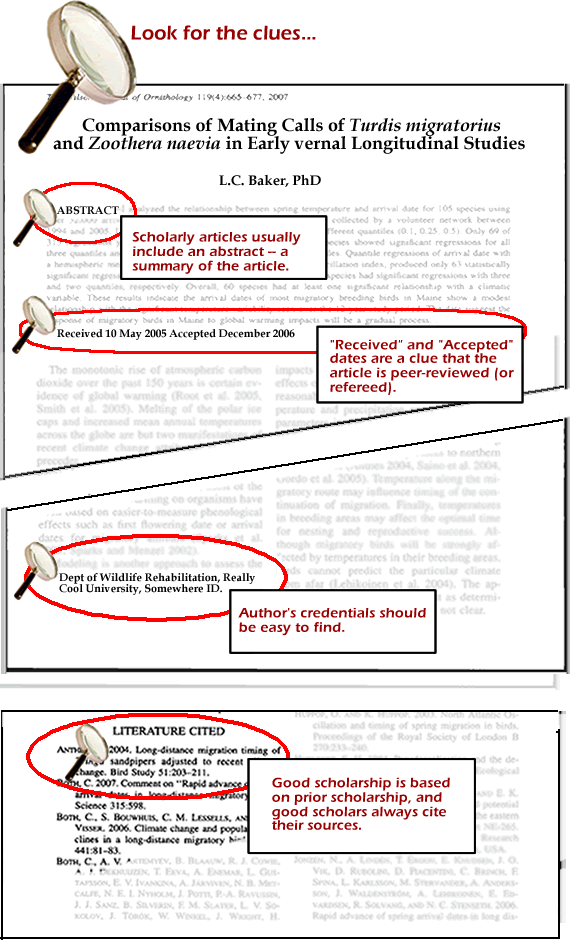
There is a subset of scholarly journals called peer-reviewed journals. Peer-reviewed journals are the most authoritative scholarly journals. If you use articles from peer-reviewed journals, these articles have been vetted by scholars in the field for quality and importance.
Watch this short video to learn how peer review works.
Popular Articles
Popular articles are usually found in newspapers and magazines. These are the types of publications we find in grocery stores, at the airport, or in bookstores. Below are some characteristics that help us identify popular articles.
- Magazines and newspapers are written for the general public. They're the type of publication we might read on the bus, on a flight, or on vacation. Some examples are: Rolling Stone, Time, Sports Illustrated, and The New York Times
- Magazine and newspaper articles are usually written by journalists or freelance writers.
- Magazine articles have a lot of glossy photos, and both magazines and newspapers have advertisements because their purpose is to make money.
- Magazine and newspaper articles are usually short and cover a wide range of topics. Sometimes they summarize research studies.
- Magazine and newspaper articles usually don't have bibliographies or lists of references.
- Newspapers are usually published daily, and magazines are usually published once a week or once a month.
These types of publications may be used to augment your academic work, but don't rely solely on them. Find popular magazines online in these resources and others:
- Online Magazines. A directory of free online magazines, organized by category.
- Magazine Directory. Information and links to many magazines, organized alphabetically by title.
Trade Publications
Trade publications include reports, newsletters, and magazines pertaining to a specific industry or trade. These publications typically feature advertisements, career information, and industry-specific news, and are generally used for marketing.
Information from trade publications is useful for supplying facts, data, specifications, and other technical information for your academic work. Find trade publications online in these resources and others:
Organizational websites. Many professional and commercial organizations link to trade publications on their websites.
- Glumac: "Green" engineering publications that provide free subscriptions.
- Tradepub.com: Free trade magazine subscriptions and technical document downloads.
- WTO publications: World Trade Organization publications in the field of economics.
Comparing Popular, Scholarly, and Trade Sources
The following chart compares popular, scholarly, and trade sources. Take note in the chart below of some of the additional characteristics of each of these types of sources not discussed thus far: language, references or bibliography of sources, and advertisements.
| Feature |
Scholarly
 |
Popular
 |
Trade
 |
|---|---|---|---|
| Examples | Journal of American Studies, Journal of Business Administration, Journal of the American Medical Association (JAMA) | Time, Newsweek, People, Entertainment Weekly, Psychology Today, Sports Illustrated | Publishers Weekly, Advertising Age, American Libraries, Chronicle of Higher Education, American Nurse, PC Week |
| Authority/authorship | Academics and professionals in a particular field. Unpaid. | Journalists, staff writers, freelance writers. Paid. | Staff writers, industry specialists, and contributing authors. Paid. |
| Audience | Scholars, professionals, or students in a particular field. | General public. | Practitioners and professionals in a specific industry, trade, or organization. |
| Editorial review | Journal editorial board and peer reviewers. Unpaid. | Articles are reviewed by the magazine's editor or editorial staff. Paid. | Articles are reviewed by the magazine's editor or editorial staff. Paid. |
| Content | Original research (such as scientific experiments, surveys and research studies). Critical analysis of topics relative to the profession. Charts, diagrams, and/or tables showing data or experiment results are often included. |
General interest, popular culture, general news, Entertainment. |
Industry related news, trends, techniques, product reviews, statistical data, upcoming events, and more. |
| Language | Specialized vocabulary. Terms and concepts specific to a particular discipline or field of study. |
"Everyday" vocabulary/terms Meant to be easily understood by all audiences. |
Vocabulary relevant to an industry, trade or organization. |
| References or bibliography of sources | A list of references or sources is provided at the end of each article. | Very rarely are any sources listed. | Some, but not all, articles contain a list of sources. |
| Advertisements | Occasionally, but highly specialized and specific to scholarly discipline (i.e. specific laboratory equipment, medical tools and drugs). | Almost always and in high quantities. | Advertising almost always present. Ads relate to relevant industry, trade, or organization. |
Tacoma Community College Library is licensed under CC BY SA 4.0
Are you starting to understand why instructors often require the use of scholarly sources? Not only are they the place to explore the scholarly conversation taking place within the scientific field, but they also tend to be more credible than popular sources.
Other Types of Sources
Of course, there are other types of sources besides scholarly and popular articles. Take a look at the guide linked to below, which comes from the Portland Community College Library. It compares sources like Twitter, Tumblr, YouTube, popular articles, and scholarly sources.
Know Your Sources: A Guide to Understanding Sources
Information Timeline
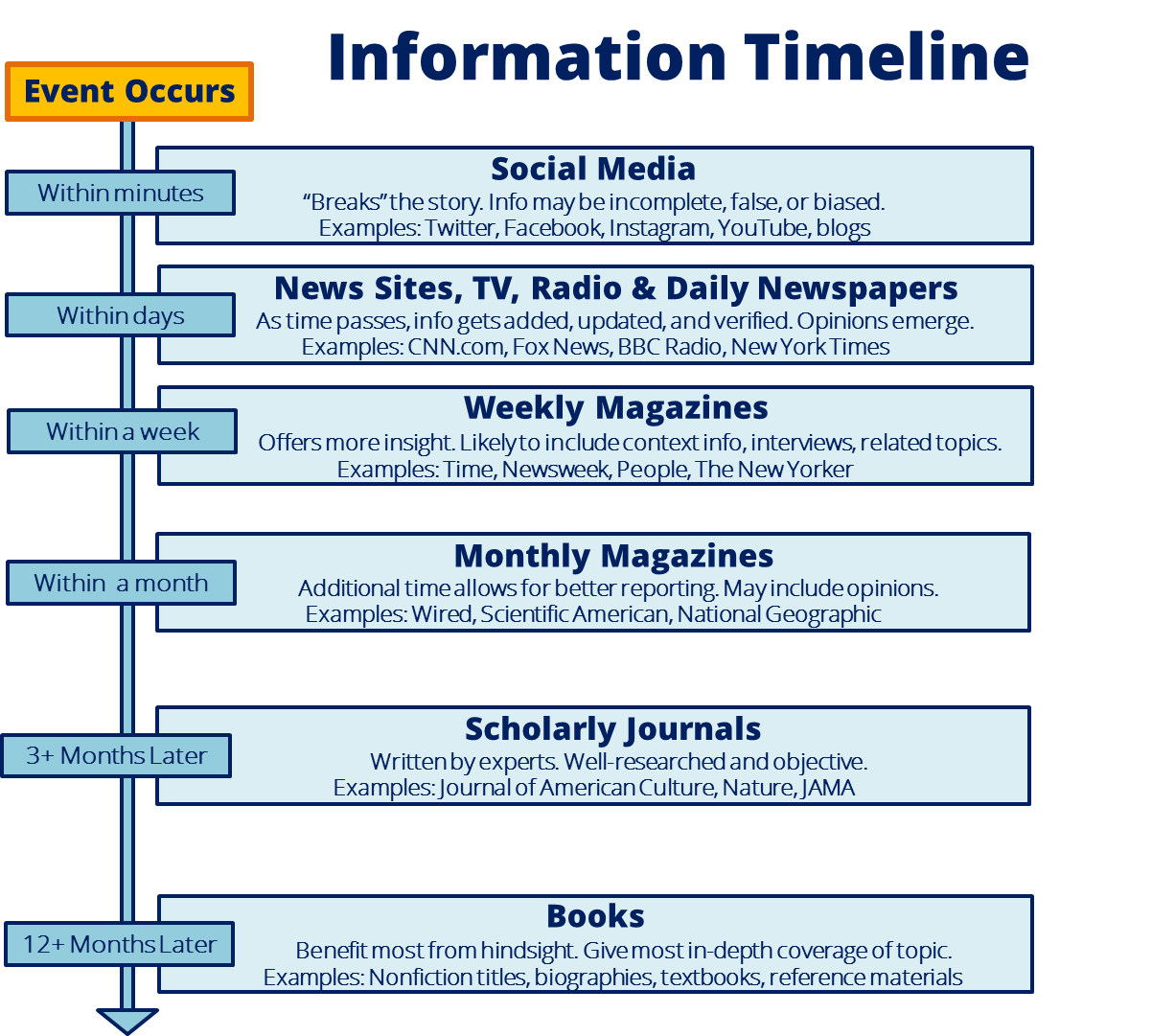
It also helps to know the information timeline (or information cycle), which helps you to know when and where you can find information about an event.
Why We Use Scholarly Articles
One of the reasons instructors want students to use scholarly articles is because of the peer-review process. Scholarly articles take a long time to write, and then they go through the peer-review process before publishing, which assures an added level of credibility and trust. Another factor in their favor is that they're written by and for experts and scholars. When you read them, you’re getting to be a part of a larger conversation that's happening between experts all over the world.
We use scholarly journal articles when we need:
- Original, primary research on a specific topic
- Articles and essays written by scholars or subject experts
- Factual, documented information to reinforce a position
- Bibliographies that point to other relevant research
Primary, Secondary and Tertiary Sources
Scholarly journal articles often report the results of original research that the scholar carried out themselves. This is called a primary source; in other words, it's the first source reporting this particular research. Other examples of primary sources are records of daily life (like diaries, letters, photos, recordings, etc.), documents like the U.S. Constitution, or a speech.
Secondary sources are articles that write about the primary source. For example, if Professor A does research to test the effects of a new antibiotic on drug-resistant bacteria, her scholarly article reporting the research results is a primary source. Then a journalist for National Geographic magazine reads the research study and decides that more people need to hear the results of the research, so she writes a shorter article explaining the main points from Professor A's article, making sure to use language that's easier for the general public to understand. This is a secondary source.
Tertiary sources are based on primary or secondary sources and may or may not be written by experts in the field. These resources typically present facts with little additional commentary. Some examples of tertiary sources are below:
- Encyclopedias and dictionaries
- Wikipedia article about space exploration
- Manuals, guidebooks, and handbooks
- Bibliographies
The definition of primary, secondary, and tertiary resources can vary depending on context. For example, criticisms of original works are considered secondary resources; however, if your research focus is a particular critic's methods, then the critic's works would be considered primary.
Other Common Source Types
Government Publications
Government publications are issued by local, state, national, or international governments. Government information includes laws, regulations, statistics, consumer information, and much more. A substantial amount of government information is available online.
Examples:
- 2010 Census Data (U.S. Census Bureau)
- National Center for Education Statistics (U.S. Department of Education)
- UNESCO Institute for Statistics (United Nations)
Websites
Use websites to find current information, company information, government information, and expert and popular opinions. Because internet sources have no quality standards, you should evaluate all information carefully to make sure it is reliable.
Examples:
Company Profiles & Industry Reports
Company profiles often include a business description, financial statements, competitors, key employees, and more. Industry reports often include market forecasts, trends, challenges, and more. You can find company profiles and industry reports in article databases.
Examples:
Identifying Scholarly Articles
Most of the time, we search for articles on the web or in library databases. Luckily, there are many scholarly articles available on the web or in databases, but how can we be sure that the article we want to use is scholarly? Below are some helpful tips.
Identifying Scholarly Articles Online
At first, it can seem difficult to identify scholarly articles, especially on the web or in library databases.
Watch this short video on Identifying Scholarly Journal Articles for a brief overview that should make it easier.
Parts of a Research Article
As the video mentioned, scholarly articles that report original research include specific sections, which makes it easier to identify them. Those sections are:
- An introduction, which sometimes includes a review of the other articles related to that topic (called a literature review),
- A methodology or methods section, which states the methods that were used to conduct the research,
- Results of the research, which contains statistics, charts, and graphs,
- A discussion and/or conclusion section, in which the author explains how the results prove (or don't prove) the hypothesis of the research study, and which suggest ideas for future research studies on this same topic.
Types of Scholarly Articles
Within scholarly journals there can be a variety of different types of articles, some of which are NOT actually scholarly in nature. The following are some of the common article types found in scholarly journals:
| Type | Description |
|---|---|
| (Empirical) research articles | Article reporting on the results of one or more studies or experiments derived from direct observation, written by the person(s) who conducted the research. This is considered one type of primary source. Look in the title or abstract for words like study, research, measure, subjects, data, effects, survey, or statistical which might indicate empirical research. Such articles are based on evidence as opposed to theory or conjecture and can usually be replicated in follow-up studies. |
| Literature reviews | Summarizes the findings of other studies or experiments; attempts to identify trends or draw broader conclusions. Scholarly in nature but not a primary source or research article, however its references to other articles will include primary sources or research articles. |
| Systematic reviews | Systematic Reviews are literature reviews focused on a single question which try to identify, appraise, select and synthesis all high-quality research evidence relevant to that question. |
| Meta-analyses | Meta-analyses are systematic reviews that combine the results of several studies (often clinical trials) using quantitative statistics. They may be used to evaluate therapeutic effectiveness, plan new studies, etc. |
| Clinical case studies | Clinical case studies present the details of real patient cases from medical or clinical practice. The cases presented are usually those that contribute significantly to the existing knowledge on the field. The study is expected to discuss the signs, symptoms, diagnosis, and treatment of a disease. |
| Clinical trials | Specific to the field of medicine, clinical trials describe the methodology, implementation, and results of controlled studies, usually undertaken with large patient groups. Clinical trial articles are also long, usually of about the same length as an original research article. |
| Editorials | Editorials are opinion pieces, just like editorials in newspapers. If they appear in scholarly journals, they will be written by a practitioner in the field; however, they are not scholarly in nature. |
| Professional communications, Book reviews, Letters to the Editor | Most scholarly journals publish articles that pertain to the workings of the profession but are not scholarly in nature. |
Empirical research articles are often used in nursing and allied health classes. These types of articles are considered primary sources rather than secondary sources.
Watch this video to learn more about empirical research articles.
What Types of Research Make an Article Empirical?
Empirical research can be done using different types of methodologies. It's important to know what these are in order to help you evaluate and interpret empirical research articles. They can fall into three categories: quantitative, qualitative, and mixed methods.
- Quantitative Research - involves the use of numerical calculations to summarize, describe and explore relationships among traits, reliance on control of variables, statistics, measurement, and experiments.
- Qualitative Research - emphasis is on conducting studies in natural settings using mostly verbal descriptions, resulting in stories and case studies rather than statistical reports.
- Mixed Methods - employs both quantitative and qualitative designs.
Searching for Scholarly Articles in Library Databases
Many library databases make it easy for to identify scholarly articles by including an option to filter the results to show only the scholarly articles. Of course, you can also find popular articles in the library databases. The library databases also often include a note indicating which articles are scholarly.
Most college library websites have search tools that allows you to search multiple databases at one time, whether you're on campus or at home. You can type in a topic and search to see all the resources on this topic.
Other library databases, such as those from ProQuest and EBSCO, also have filtering options like this. You should be sure to look for words like peer-reviewed, scholarly, or academic when exploring a new database for this feature.
We will explore library databases in more detail on the next page.
Searching for Scholarly Articles on the Web
Another way to find scholarly articles is using Google Scholar. You search it the same way as you do Google, but instead of looking for websites, Google Scholar searches for academic resources such as electronic books, scholarly articles, and reports.
Advantage of using Google Scholar:
- Most people are already familiar with how to search Google.
- You don't need to log in to a specific library's databases to search it.
Disadvantages of using Google Scholar:
- You will find electronic books and reports too, so you will also need to evaluate each source located to make sure it's a scholarly article.
- Not everything you find there is available for free. You might find a perfect article, but when you try to access it, you are told you have to pay.
How to Read a Scholarly Article
It can be intimidating to read a scholarly article because the language is often more advanced and specialized, but you don't need to be experts to get useful information out of a scholarly article.
Watch this video on how to read a scholarly article to learn tips that will save time and frustration.
Attributions:
This content was adapted from a resource on Canvas Commons "Scholarly vs. Popular Sources" by Highline College and is licensed under a CC BY-NC 4.0 license unless otherwise noted.
Other Common Source Types:
This content was adapted from a resource on Canvas Commons “Understanding Source Types" by College of Saint Benedict and Saint John's University Libraries and is licensed under a CC BY-NC 4.0 license.
Peer-Review Video:
“Peer Review in 3 Minutes” [Video] by North Carolina State University Libraries, licensed under a CC BY-NC-SA 3.0 US License.
Empirical Research Video:
This content was adapted from a resource on Canvas Commons “Research Skills for Healthcare” by Tacoma Community College Library is licensed under a CC BY-NC 4.0 license.
Background Colour
Font Face
Font Kerning
Font Size
Image Visibility
Letter Spacing
Line Height
Link Highlight
Text Colour