Boolean Operators

Overview

Most databases don't understand the natural language we speak and need help understanding what we're looking to find. For this, they require a special set of conventions, including: Logical or Boolean operators, wildcard and truncation symbols, and nesting. Databases and internet search engines apply these rules differently, so check the HELP files in the database you are using to find out more.

Boolean Logic consists of three logical operators (connectors): AND, OR and NOT.

Key Features of Boolean Operators

Key Features of Boolean Operators
Boolean Operator Description Example
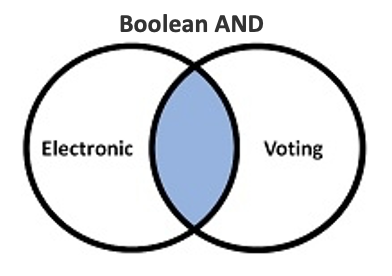
AND
  • Finds sources containing two or more ideas.
  • The database will only retrieve items containing both words.
  • AND narrows your search.
  • You can use AND many times in one search.
Boolean AND Example Diagram
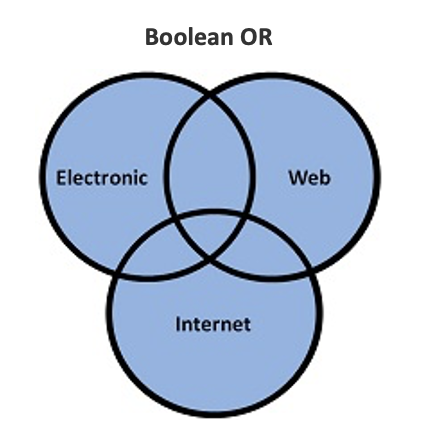
OR
  • Use OR when searching for synonyms.
  • OR tells the database that the words can be used interchangeably, so it will retrieve items containing either word.
  • OR broadens your search to include synonyms and related words.
  • You can use OR many times in one search.
  • Nesting allows combining OR and AND with parentheses to group synonyms.
Boolean OR Example Diagram
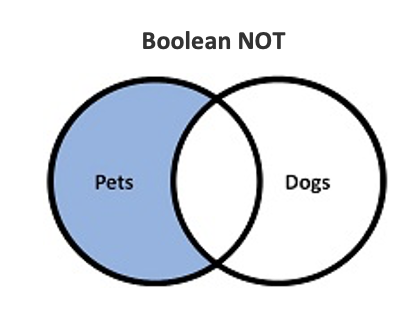
NOT
  • Use NOT when you wish to exclude records from your search results.
  • Be careful when using NOT! The term you want may be present in an important way in results that also contain the word you wish to avoid.
Boolean NOT Example Diagram

This content was adapted from a resource on Canvas Commons “Introduction to Research” by Tacoma Community College Library and is licensed under a CC BY-NC 4.0 license.


Last modified: Saturday, August 9, 2025, 4:09 PM
Accessibility

Background Colour Background Colour

Font Face Font Face

Font Kerning Font Kerning

Font Size Font Size

1

Image Visibility Image Visibility

Letter Spacing Letter Spacing

0

Line Height Line Height

1.2

Link Highlight Link Highlight

Text Colour Text Colour