
Module 10: Biochemical Testing
Section outline
-
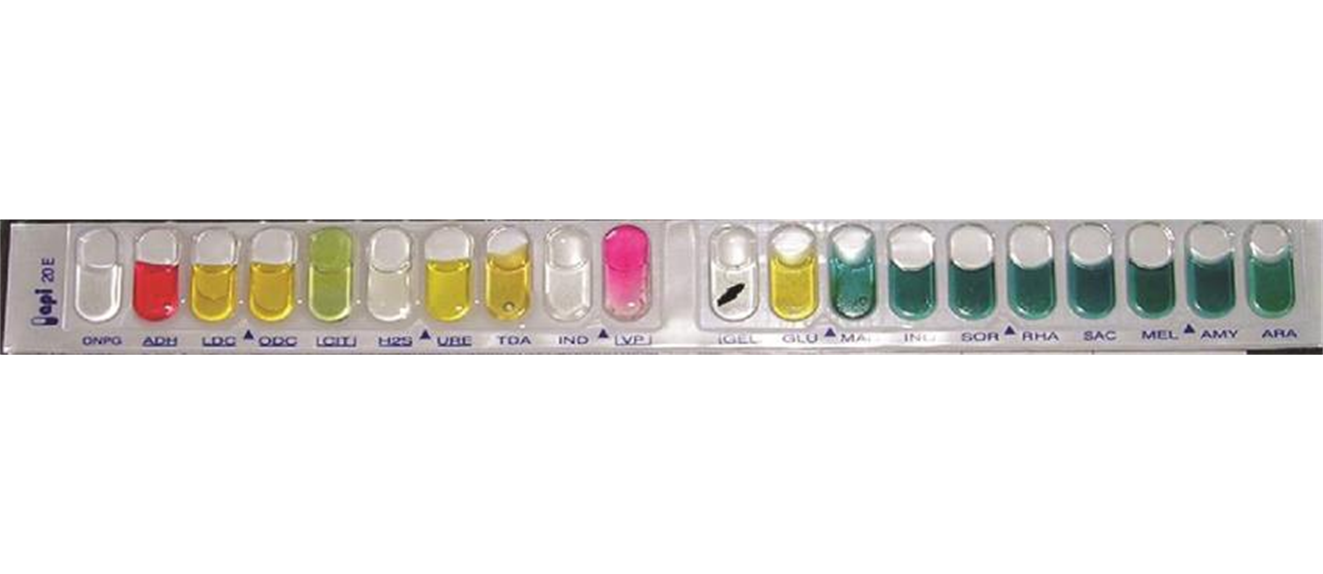
A multiplexed biochemical test such as API 20 E is shown. The API 20NE test strip is used to identify specific strains of gram-negative bacteria outside the Enterobacteriaceae. Here is an API 20NE test strip result for Photobacterium damselae ssp. piscicida. (Source of Image: Figure 8.18, OpenStax Microbiology, CC BY License)
Biochemical testing is based on the fact that microbes have microbial metabolism involving microbial biochemistry. Different microbes have different metabolic capabilities. Biochemical testing can therefore be used to characterize an unknown microbe and figure out the identity of the microbes. Characterizing and identifying an unknown microbe based on biochemical testing is not only an intellectual exercise for a microbiologist. Characterizing and identifying an unknown microbe based on biochemical testing is in healthcare a critical task to determine the identity of the pathogen causing illness in the patient and finding the appropriate therapeutic intervention. Biochemical tests for fermentation, gelatin hydrolysis, starch hydrolysis, casein hydrolysis, urea hydrolysis, citrate utilization, catalase activity, tryptophane hydrolysis are some examples.Upon completion of this module, you will be able to:
- Obj. 1 Be
able to perform the following biochemical tests and understand how they work:
carbohydrate fermentation, gelatin hydrolysis, starch hydrolysis, casein
hydrolysis, urea hydrolysis, citrate utilization, catalase activity, tryptophan
hydrolysis (indole test). (C.O. # 4 Identify unknown bacteria using various
physiological tests.)
- Obj. 2 Be
able to relate the results of the tests performed to the different types of
metabolic activities carried out by individual bacterial species. (C.O. # 4 Identify
unknown bacteria using various physiological tests.)
To achieve these objectives:
- Read the Module #10 Introduction
- Read
and view the materials in the Module “LAB
10: BIOCHEMICAL TESTING” in the Pressbooks book. It shows commonly used
biochemical tests for fermentation, gelatin hydrolysis, starch
hydrolysis, casein hydrolysis, urea hydrolysis, citrate utilization, catalase
activity, tryptophane hydrolysis.
- Read Chapter #10 in Medical Microbiology for Nursing and Allied Health Lab Manual.
- Complete the following specific activities in the module:
- Download and read the lecture slides about fermentation (file fermentation v08)
- Take the quiz about fermentation.
- Download and read the lecture slides about hydrolytic and degradative enzymes (file Hydrolytic _degradative enzymes v09b)
- Take the quiz about hydrolytic and degradative enzymes (Hydrolysis)
- Download and read the lecture slides about urea – hydrolytic reactions (file hydrolytic reactions - urea v02b)
- Take the quiz about urease
- Download and read the lecture slides about catalase and oxidase test (file biooxidation & respiration v09b)
- Take the quiz about catalase and oxidase test
- The instructor will determine which lab test you will actually conducting in the lab from the book Module “LAB 10: BIOCHEMICAL TESTING”
- Assignment: Upload the lab report of the actual assigned lab test that your instructor assigned you to perform.
Module Pressbooks Resources and Activities
You will find the following resources and activities in this module at the Pressbooks website. Click on the links below to access or complete each item.
-
-
Dear students,
Please download and read the lecture slides about fermentation (file fermentation v08).
-
Dear students,
Please download and read the lecture slides about urea – hydrolytic reactions (file hydrolytic reactions - urea v02b)
-
Dear students,
Please download and read the lecture slides about hydrolytic and degradative enzymes (file Hydrolytic _degradative enzymes v09b).
-
Dear students,
Please download and read the lecture slides about catalase and oxidase test (file biooxidation & respiration v09b)
-
Dear students,
The quiz is aligned with
- Obj. 1 Be able to perform the following biochemical tests and understand how they work: carbohydrate fermentation, gelatin hydrolysis, starch hydrolysis, casein hydrolysis, urea hydrolysis, citrate utilization, catalase activity, tryptophan hydrolysis (indole test). (C.O. # 4 Identify unknown bacteria using various physiological tests.)
- Obj. 2 Be able to relate the results of the tests performed to the different types of metabolic activities carried out by individual bacterial species. (C.O. # 4 Identify unknown bacteria using various physiological tests.)
Please take quiz/assignment during dates of availability:
Dates of availability: xx/xx/202x to xx/xx/202x
Attempts: unlimited within dates of availability.
Grade/score: Highest score of attempt counts.
Length of time per attempt: You have xxx minutes for each attempt.
Uninterrupted attempts required.
Number of questions: There are 14 questions.
Contribution towards final grade: yes/no
The quiz has to be taken in the learning management system, in this case Canvas or Moodle.
Email, paper, or any other type of submissions will not be accepted.
Sincerely,
-
Dear students,
The quiz is aligned with
- Obj. 1 Be able to perform the following biochemical tests and understand how they work: carbohydrate fermentation, gelatin hydrolysis, starch hydrolysis, casein hydrolysis, urea hydrolysis, citrate utilization, catalase activity, tryptophan hydrolysis (indole test). (C.O. # 4 Identify unknown bacteria using various physiological tests.)
- Obj. 2 Be able to relate the results of the tests performed to the different types of metabolic activities carried out by individual bacterial species. (C.O. # 4 Identify unknown bacteria using various physiological tests.)
Please take quiz/assignment during dates of availability:
Dates of availability: xx/xx/202x to xx/xx/202x
Attempts: unlimited within dates of availability.
Grade/score: Highest score of attempt counts.
Length of time per attempt: You have xxx minutes for each attempt.
Uninterrupted attempts required.
Number of questions: There are 18 questions.
Contribution towards final grade: yes/no
The quiz has to be taken in the learning management system, in this case canvas or Moodle.
Email, paper, or any other type of submissions will not be accepted.
Sincerely,
Your instructor - Obj. 1 Be able to perform the following biochemical tests and understand how they work: carbohydrate fermentation, gelatin hydrolysis, starch hydrolysis, casein hydrolysis, urea hydrolysis, citrate utilization, catalase activity, tryptophan hydrolysis (indole test). (C.O. # 4 Identify unknown bacteria using various physiological tests.)
-
Dear students,
The quiz is aligned with
- Obj. 1 Be able to perform the following biochemical tests and understand how they work: carbohydrate fermentation, gelatin hydrolysis, starch hydrolysis, casein hydrolysis, urea hydrolysis, citrate utilization, catalase activity, tryptophan hydrolysis (indole test). (C.O. # 4 Identify unknown bacteria using various physiological tests.)
- Obj. 2 Be able to relate the results of the tests performed to the different types of metabolic activities carried out by individual bacterial species. (C.O. # 4 Identify unknown bacteria using various physiological tests.)
Please take quiz/assignment during dates of availability:
Dates of availability: xx/xx/202x to xx/xx/202x
Attempts: unlimited within dates of availability.
Grade/score: Highest score of attempt counts.
Length of time per attempt: You have xxx minutes for each attempt.
Uninterrupted attempts required.
Number of questions: There are 16 questions.
Contribution towards final grade: yes/no
The quiz has to be taken in the learning management system, in this case canvas or Moodle.
Email, paper, or any other type of submissions will not be accepted.
Sincerely,
Your instructor - Obj. 1 Be able to perform the following biochemical tests and understand how they work: carbohydrate fermentation, gelatin hydrolysis, starch hydrolysis, casein hydrolysis, urea hydrolysis, citrate utilization, catalase activity, tryptophan hydrolysis (indole test). (C.O. # 4 Identify unknown bacteria using various physiological tests.)
-
Dear students,
the quiz is aligned with
- Obj. 1 Be able to perform the following biochemical tests and understand how they work: carbohydrate fermentation, gelatin hydrolysis, starch hydrolysis, casein hydrolysis, urea hydrolysis, citrate utilization, catalase activity, tryptophan hydrolysis (indole test). (C.O. # 4 Identify unknown bacteria using various physiological tests.)
- Obj. 2 Be able to relate the results of the tests performed to the different types of metabolic activities carried out by individual bacterial species. (C.O. # 4 Identify unknown bacteria using various physiological tests.)
Please take quiz/assignment during dates of availability:
Dates of availability: xx/xx/202x to xx/xx/202x
Attempts: unlimited within dates of availability.
Grade/score: Highest score of attempt counts.
Length of time per attempt: You have xxx minutes for each attempt.
Uninterrupted attempts required.
Number of questions: There are 8 questions.
Contribution towards final grade: yes/no
The quiz has to be taken in the learning management system, in this case Canvas or Moodle.
Email, paper, or any other type of submissions will not be accepted.
Sincerely,
Your instructor - Obj. 1 Be able to perform the following biochemical tests and understand how they work: carbohydrate fermentation, gelatin hydrolysis, starch hydrolysis, casein hydrolysis, urea hydrolysis, citrate utilization, catalase activity, tryptophan hydrolysis (indole test). (C.O. # 4 Identify unknown bacteria using various physiological tests.)
-
Opened: Tuesday, December 23, 2025, 12:00 AMDue: Tuesday, December 30, 2025, 12:00 AM
The assignment is aligned with:
- Obj. 1 Be able to perform the following biochemical tests and understand how they work: carbohydrate fermentation, gelatin hydrolysis, starch hydrolysis, casein hydrolysis, urea hydrolysis, citrate utilization, catalase activity, tryptophan hydrolysis (indole test). (C.O. # 4 Identify unknown bacteria using various physiological tests.)
- Obj. 2 Be able to relate the results of the tests performed to the different types of metabolic activities carried out by individual bacterial species. (C.O. # 4 Identify unknown bacteria using various physiological tests.)
Assignment: Upload the lab report of the actual assigned lab test that your instructor assigned you to perform (to be announced).
The instructor will determine which lab test you will actually conducting in the lab from the book Module “LAB 10: BIOCHEMICAL TESTING”
Upload the lab report of the actual assigned lab test that your instructor assigned you to perform.
The structure of the lab report depends on requirements of the instructor.
Motivation:
Motivation for the lab report is that students experience and demonstrate the skills 1) to apply the scientific method, 2) apply standard techniques in microbiology, 3) process and understand the underlying theoretical concepts of microbiology.
Instruction:
One format for a lab report is to report the 1) title of the experiment or test, 2) the hypothesis or research question of the experiment or test, 3) the prediction, 4) the procedure, 5) the results, and 6) the conclusion.
Example of a lab report -
1) title of the experiment or test: Catalase test
2) the hypothesis or research question of the experiment or test: It is hypothesized that the bacteria to be tested will be catalase positive OR the research question studied is whether or not the tested bacteria are calatase positive
3) the prediction: If the bacteria are catalase positive, then formation of bubbles will be observed during the test
4) the procedure: Transfer bacteria of interest onto microscopic slide using aseptic techniques. Apply enough droplets of 3% hydrogen peroxide solution, so that microbes are covered. Observe microbes in 3% hydrogen peroxide solution for 1 to 3 minutes for the formation of bubbles. Document the results. In parallel, include a positive control of a known lab strain that is positive for catalase
5) the results:
The bacteria of interest did/ did not form bubbles (circle appropriate result).
The positive control did/did not form bubbles (circle appropriate result).
Include photos if available.
6) the conclusion:
The positive control did/did not work , because the bubbles were/were not formed (circle appropriate result). Therefore, the test reagents and the test itself is/is not working properly (circle appropriate result).
The unknown/bacteria of interest are/are not catalase positive, because the bacteria did/did not form bubbles (circle appropriate result). The results do/don’t support the hypothesis (circle appropriate result).
You can upload your report as a file, or write by hand on a piece of paper and upload a photo of your handwritten report.
- Obj. 1 Be able to perform the following biochemical tests and understand how they work: carbohydrate fermentation, gelatin hydrolysis, starch hydrolysis, casein hydrolysis, urea hydrolysis, citrate utilization, catalase activity, tryptophan hydrolysis (indole test). (C.O. # 4 Identify unknown bacteria using various physiological tests.)
- Obj. 1 Be
able to perform the following biochemical tests and understand how they work:
carbohydrate fermentation, gelatin hydrolysis, starch hydrolysis, casein
hydrolysis, urea hydrolysis, citrate utilization, catalase activity, tryptophan
hydrolysis (indole test). (C.O. # 4 Identify unknown bacteria using various
physiological tests.)
Background Colour
Font Face
Font Kerning
Font Size
Image Visibility
Letter Spacing
Line Height
Link Highlight
Text Colour