
Module 6: Lymphatic System
Section outline
-
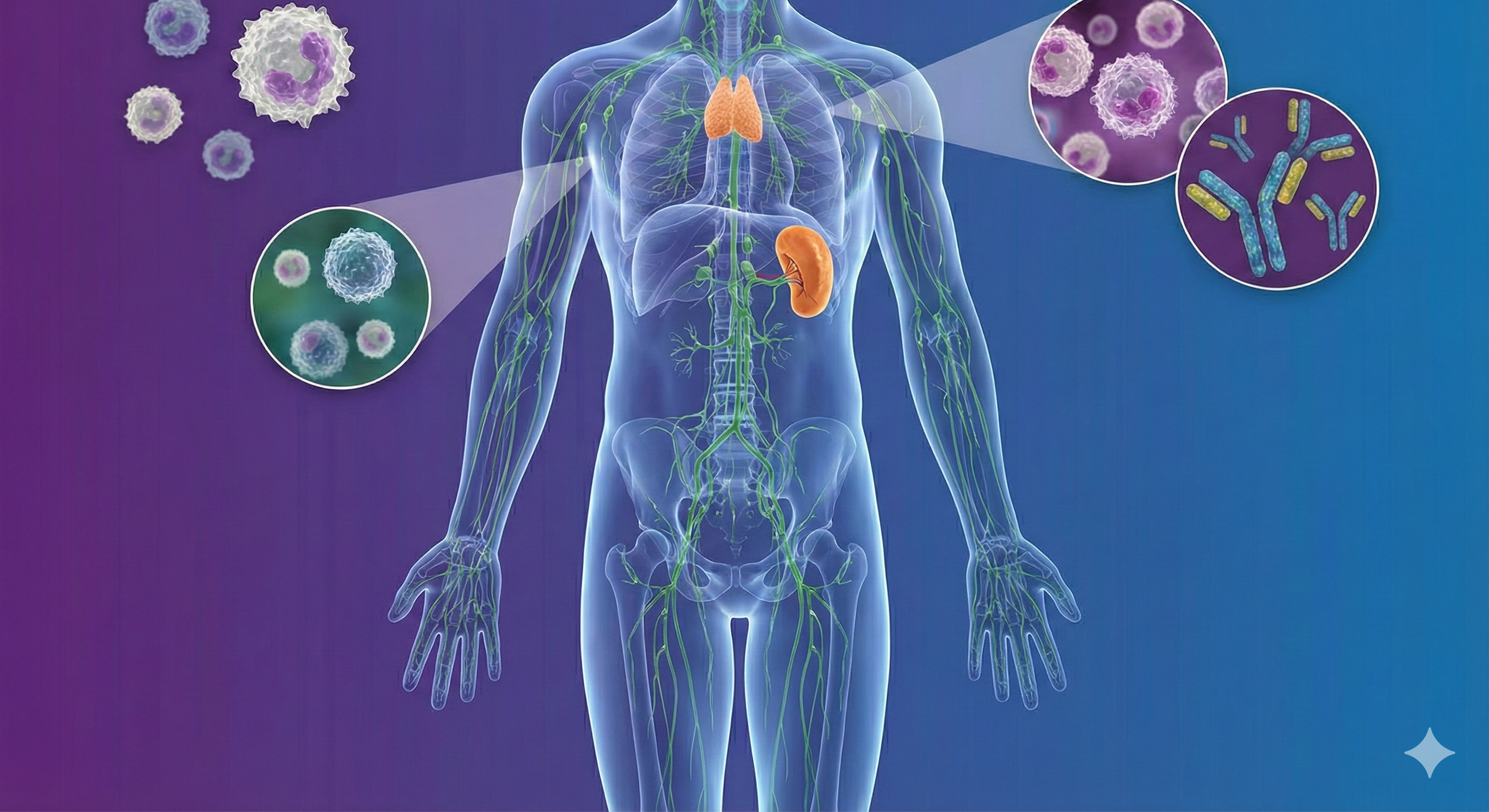
(Image: lymphatic system and immune cells. Image created with Google Gemini).
Introduction: Your Body's Levees and Defense ForceLiving in Louisiana, we know that managing water and protecting our boundaries are full-time jobs. Your body faces similar challenges every day, handled by two closely interconnected networks: the lymphatic and immune systems
. Think of the lymphatic system as your body’s internal drainage commission—much like our pumps and levees, it works to drain excess tissue fluids (interstitial fluid) and return them to the bloodstream to prevent "flooding" or swelling in your tissues . But this system does more than just move fluid; it partners with your immune system to act as a high-tech security team . While the lymphatic vessels transport fluids, the immune system stations specialized cells —such as macrophages, B cells, and T cells—at key checkpoints to filter out pathogens and launch targeted attacks against infections. In this lab, you will explore the anatomy of these defenders. You will trace the "drainage map" of lymph flowing from your feet back to your heart and examine the critical organs where immune cells train and work, such as the thymus, spleen, and lymph nodes . You will also differentiate between your body's immediate "first responders" (Innate Immunity) and its specialized "SWAT team" (Adaptive Immunity) . From understanding how your body handles a rusty nail wound to seeing how vaccines build your defenses against viruses, this lab will help you visualize the life-saving teamwork happening inside you right now . Upon completion of this module, you will be able to:
- Locate and identify major lymph vessels and organs.(C.O. # 3)
- Describe the structure and function of primary and secondary lymphatic organs. (C.O. # 3)
- Discuss the cells of the immune system, how they function, and their relationship with the lymphatic system. (C.O. # 3)
- Identify the specific types of cells that comprise the immune system. (C.O. # 3)
- Differentiate between innate and adaptive immunity. (C.O. # 3)
To achieve these objectives:
- Read the Module 6 Introduction
- Complete the Module 6 Pre-Lab exercises and Module 6 Pre-Lab Quiz before the DUE DATE (see the Course Calendar).
- Complete the Module 6 Lab Exercises [in-class or online].
- Complete the Module 6 Post-Lab Quiz
**Please note: the final project should be submitted in this module or the next. Consider this when assigning activities and for grading time.
Module Pressbooks Resources and Activities
You will find the following resources and activities in this module at the Pressbooks website. Click on the links below to access or complete each item.
- Locate and identify major lymph vessels and organs.(C.O. # 3)
Background Colour
Font Face
Font Kerning
Font Size
Image Visibility
Letter Spacing
Line Height
Link Highlight
Text Colour