
Module 14 Rapid Diagnostic
Section outline
-
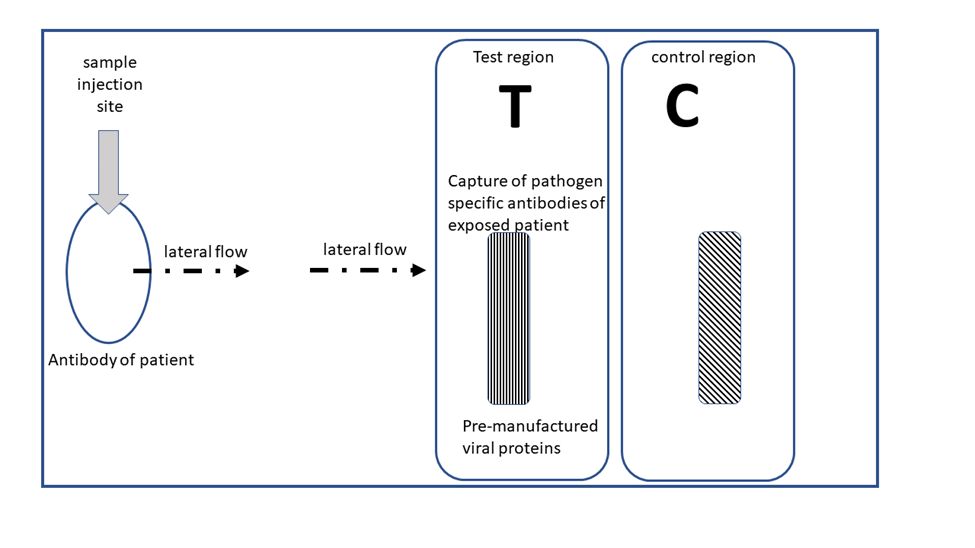
Recent advances in biotechnology have given rise to new rapid diagnostic testing methods in microbiology and human health. As a patient going to urgent care or doctor’s office you may have encountered rapid diagnostic tests for detecting the influenza virus or the virus causing COVID19. Most likely, you may use a rapid diagnostic test as an allied health professional at some time in the future. This lab module gives you some information about rapid diagnostic tests to prepare you better for your professional career. Content areas about rapid diagnostic tests include: the advantages, uses, working principles, and details of lateral flow immunochromatography. (Image: Schematic of a positive test result of a lateral flow immunochromatography test for a virus. By Illya Tietzel, 2025 Creative Commons 4.0 BY).
Upon completion of this module, you will be able to:
- Obj. 1 Remember advantages of rapid diagnostic testing (C.O. #4: Identify unknown bacteria using various
physiological tests.) & (C.O. # 6 : In a virtual setting) or (Face-to-Face
setting) Perform essential microbiological techniques in a simulated
environment with confidence, utilizing digital tools to analyze and interpret
virtual and hands-on experimental data, and apply their virtual and/or hands-on
laboratory skills to clinical and public health contexts in nursing and allied
health.)
- Obj. 2 Distinguish between different uses of rapid diagnostic tests (C.O. # 4 & C.O. # 6)
- Obj. 3 Distinguish between the different working principles of different rapid diagnostic tests (C.O. # 4 & C.O. # 6).
- Obj. 4 Identify
positive, negative, and erroneous or inclusive test result for lateral flow
immunochromatography (C.O. # 4 & C.O. # 6)
- Obj. 5 Distinguish
between the different working principles of different rapid diagnostic tests (C.O. # 4 & C.O. # 6)
To achieve these objectives:
- Read the Module #14
Introduction
- Read and view the materials
in the Module # Lab 14 Rapid
Diagnostic of the Pressbooks book
- Please download and read the lecture slides about Rapid Diagnostic tests.
- Complete the
- quiz entitled “Quiz about rapid diagnostic tests”
- Module #14 Assignment Assignment Pubmed Central search for articles about lateral flow chromatography and detection of viruses (Basic Digital Literacy: Perform Online Searches on a scientific website for biomedical literature to find accurate and relevant information: Assignment Pubmed Central search for articles about lateral flow chromatography and detection of viruses).
Module Pressbooks Resources and Activities
You will find the following resources and activities in this module at the Pressbooks website. Click on the links below to access or complete each item.
-
-
Dear students,
please download and read the lecture slides.
-
Students mustMark as done
Motivation:
This assignment addresses course outcome(s) #6 (In a virtual setting) or (Face-to-Face setting) Perform essential microbiological techniques in a simulated environment with confidence, utilizing digital tools to analyze and interpret virtual and hands-on experimental data, and apply their virtual and/or hands-on laboratory skills to clinical and public health contexts in nursing and allied health and module learning objective(s) Obj. 5 Distinguish between the different working principles of different rapid diagnostic tests. It also addresses basic digital literacy skills such as performing online searches to find accurate and relevant information using search engines.
Allied Health professional should be able to find accurate information about biomedical topics using scientific search engines such as Pubmed or PubMed Central.
As the module was aiming to increase the knowledge base of students about rapid diagnostic tests such as lateral flow immuno-chromatography, students will use PubMed Central to find information about lateral flow immuno-chromatography and detection of viruses.
Instruction:
Open an internet browser. Type into the search engine the words:” pubmed central”.
The search result should show the website or URL for PubMed Central. It is [https://pmc.ncbi.nlm.nih.gov/].
Clicking on the link a new website should open.
Into the search bar, the students paste phrase: lateral flow immunochromatography AND detection of viruses.
The results page should show about 9,015 biomedical articles.
The students should then select one article of their choice and upload the information into the assignment. Please upload the title of the article, the names of the authors, and the information about the scientific journal or book.
For example, a fictitious student has chosen this article:
- Title: A novel diagnostic approach to detecting porcine epidemic diarrhea virus: The lateral immunochromatography assay.
- Authors: Kim YK, Lim SI, Cho IS, Cheong KM, Lee EJ, Lee SO, Kim JB, Kim JH, Jeong DS, An BH, An DJ.
- Name of Journal or book: J Virol Methods. 2015 Sep 2;225:4-8. doi: 10.1016/j.jviromet.2015.08.024.
More background information: Our original search phrase ( lateral flow immunochromatography AND detection of viruses) had the word and in capital letters as AND. This is on purpose. The PubMed Central search engine considers AND as a command. The command means to combine the search terms before and after AND. In this case we combined lateral flow immunochromatography with the detection of viruses.
Evaluation rubric:
Expectations met (100 points) – a scientific article was uploaded with title of the article, the names of the authors, and the name of the journal or book
Expectations partially met (70 points) – 2 out of 3 elements (title, authors, name of journal or book) were uploaded.
Expectations mostly incomplete (25 points) - 1 out of 3 elements (title, authors, name of journal or book) were uploaded.
Expectations mostly incomplete (0 points) - 0 out of 3 elements (title, authors, name of journal or book) were uploaded.
Students can upload files as text or word processing files in the format of .docx, .odt, .txt, .pdf. Photos of handwritten or printed papers can be uploaded as photos in .jpg, or .png, or other suitable files. Please make sure that your name as a student is on the uploaded document.
The instructor will set the deadline for the assignment. Within the deadline of the assignment multiple attempts are allowed to upload files or photos.
-
Dear students,
The quiz aligns with the following module learning objectives and course objectives/outcomes:
- Obj. 1 Remember advantages of rapid diagnostic testing (C.O. #4: Identify unknown bacteria using various physiological tests.) & (C.O. # 6 : In a virtual setting) or (Face-to-Face setting) Perform essential microbiological techniques in a simulated environment with confidence, utilizing digital tools to analyze and interpret virtual and hands-on experimental data, and apply their virtual and/or hands-on laboratory skills to clinical and public health contexts in nursing and allied health.)
- Obj. 2 Distinguish between different uses of rapid diagnostic tests (C.O. # 4 & C.O. # 6)
- Obj. 3 Distinguish between the different working principles of different rapid diagnostic tests (C.O. # 4 & C.O. # 6).
- Obj. 4 Identify positive, negative, and erroneous or inclusive test result for lateral flow immunochromatography (C.O. # 4 & C.O. # 6)
- Obj. 5 Distinguish between the different working principles of different rapid diagnostic tests (C.O. # 4 & C.O. # 6)
Please take quiz/assignment during dates of availability:
Dates of availability: xx/xx/202x to xx/xx/202x
Attempts: unlimited within dates of availability.
Grade/score: Highest score of attempt counts.
Length of time per attempt: You have xxx minutes for each attempt.
Uninterrupted attempts required.
Number of questions: There are 20 questions.
Contribution towards final grade: yes/no
The quiz has to be taken in the learning management system, in this case Canvas or Moodle.
Email, paper, or any other type of submissions will not be accepted.
Sincerely,
- Obj. 1 Remember advantages of rapid diagnostic testing (C.O. #4: Identify unknown bacteria using various physiological tests.) & (C.O. # 6 : In a virtual setting) or (Face-to-Face setting) Perform essential microbiological techniques in a simulated environment with confidence, utilizing digital tools to analyze and interpret virtual and hands-on experimental data, and apply their virtual and/or hands-on laboratory skills to clinical and public health contexts in nursing and allied health.)
- Obj. 1 Remember advantages of rapid diagnostic testing (C.O. #4: Identify unknown bacteria using various
physiological tests.) & (C.O. # 6 : In a virtual setting) or (Face-to-Face
setting) Perform essential microbiological techniques in a simulated
environment with confidence, utilizing digital tools to analyze and interpret
virtual and hands-on experimental data, and apply their virtual and/or hands-on
laboratory skills to clinical and public health contexts in nursing and allied
health.)
Background Colour
Font Face
Font Kerning
Font Size
Image Visibility
Letter Spacing
Line Height
Link Highlight
Text Colour